
How to Implement Skills-Based Hiring With Your ATS: A 2026 Checklist for Asia-Pacific Teams
The gap between wanting skills-based hiring and actually doing it is where most companies stall. Across Asia-Pacific, hiring teams know that evaluating candidates on demonstrated abilities produces better outcomes than filtering by degrees or years of experience. Yet the shift from intention to execution remains the hardest part, particularly when existing tools were not built to support it.
This guide breaks down how to implement skills-based hiring through your Applicant Tracking System (ATS), step by step. It covers the foundational components, the ATS capabilities that matter most, the mistakes that derail implementation, and a practical checklist designed for teams hiring in Asia. Whether you are building a skills-first process from scratch or upgrading an existing workflow, this is a structured path from planning to measurement.
Quick Summary: What Is Skills-Based Hiring Implementation?
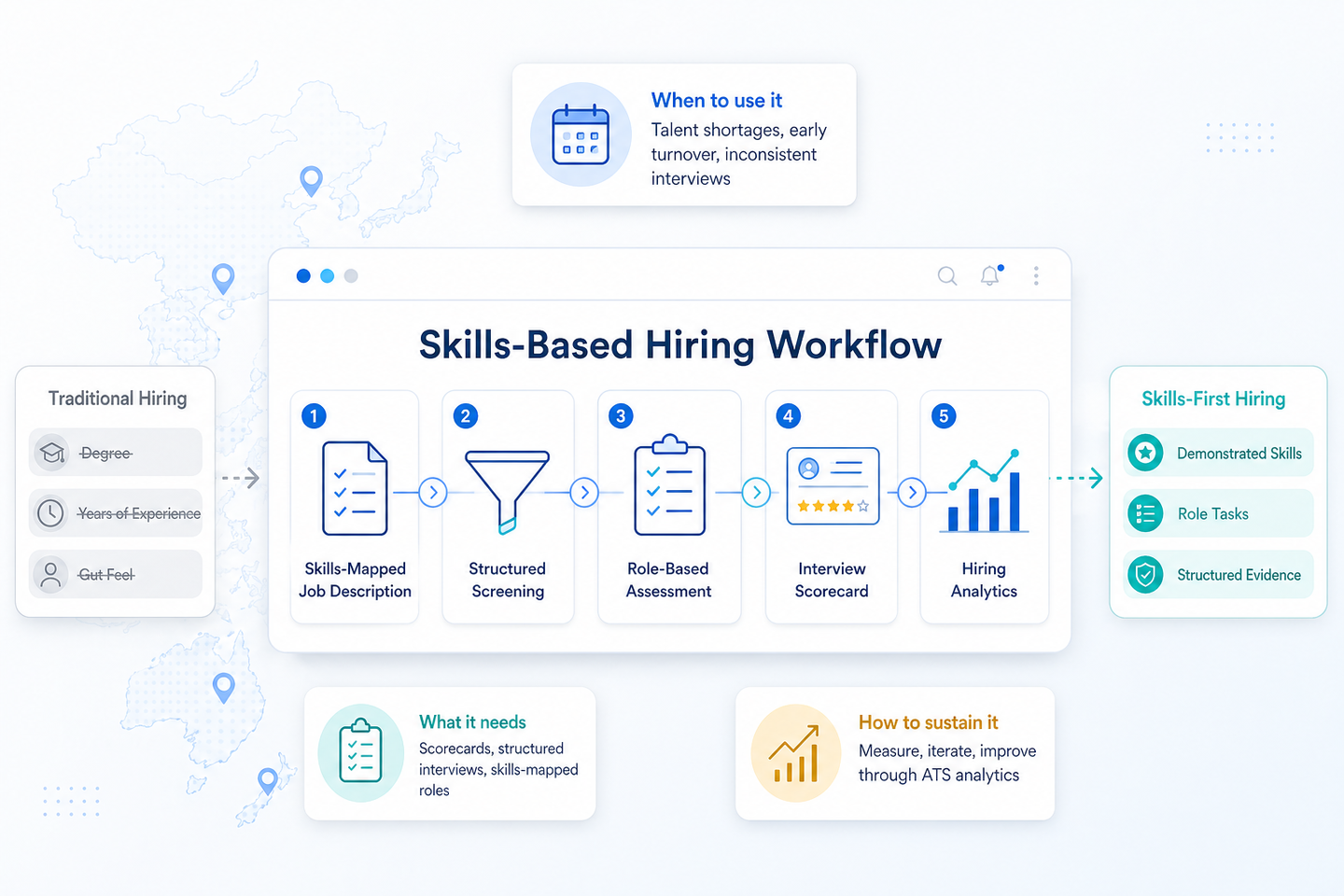
Skills-based hiring implementation is the process of redesigning recruitment workflows to evaluate candidates on demonstrated competencies, such as technical proficiency, problem-solving, and role-specific tasks, rather than relying primarily on degrees or years of experience. It requires coordinated changes to job descriptions, screening criteria, interview structure, and the ATS that underpins them.
Companies should pursue this shift when facing talent shortages, high early-turnover, or inconsistent interview quality across hiring managers. Success depends on structured interviews, skills-mapped job descriptions, standardised scorecards, and an ATS that can enforce these processes at scale. Results vary by organisational readiness, and implementation is most effective when treated as an ongoing system rather than a one-time project.
For a deeper look at how an ATS supports the entire recruitment lifecycle, see our guide on how to streamline the recruitment process for SMEs with an ATS.
Why Is Skills-Based Hiring Gaining Traction in Asia?
Skills-based hiring is accelerating across Asia-Pacific because of acute talent shortages, rapid digital transformation, and a growing body of evidence that degrees alone do not predict on-the-job performance.
The data makes the case clearly. According to the World Economic Forum's Future of Jobs Report 2025, employers expect 39% of workers' core skills to change by 2030, making static credentials an increasingly unreliable proxy for capability. Meanwhile, McKinsey research found that hiring for skills is five times more predictive of job performance than hiring for education and more than twice as predictive as hiring for work experience.
Across APAC, employers are increasingly shifting towards skills-based workforce decisions rather than relying mainly on traditional credentials. Aon’s 2025 APAC Skills Impact Survey found that 90% of organisations view skills-related initiatives as important, 68% already have a formal skills framework, and 61% have implemented skills-based initiatives.
Japan is facing a demographic shift that makes skills-based hiring an economic necessity. With 30% of its population aged 65 and above, Japan will need to widen its talent pools significantly in the coming years, and rigid degree filters only narrow them further. In Singapore, 84% of employers reported difficulty filling roles in 2022, a 20% increase from the prior year, intensifying the pressure to evaluate candidates on what they can do rather than where they studied. Across Southeast Asia, the digital skills gap continues to widen, with sectors like technology and data centres struggling to find specialists trained through traditional pathways alone.
Companies like EY, Google, and IBM have already removed degree requirements for many positions globally, and this shift is now filtering through to APAC hiring practices. For hiring teams in the region, the question is no longer whether to adopt skills-based hiring but how to operationalise it effectively.
What Are the Core Components of a Skills-Based Hiring Process?
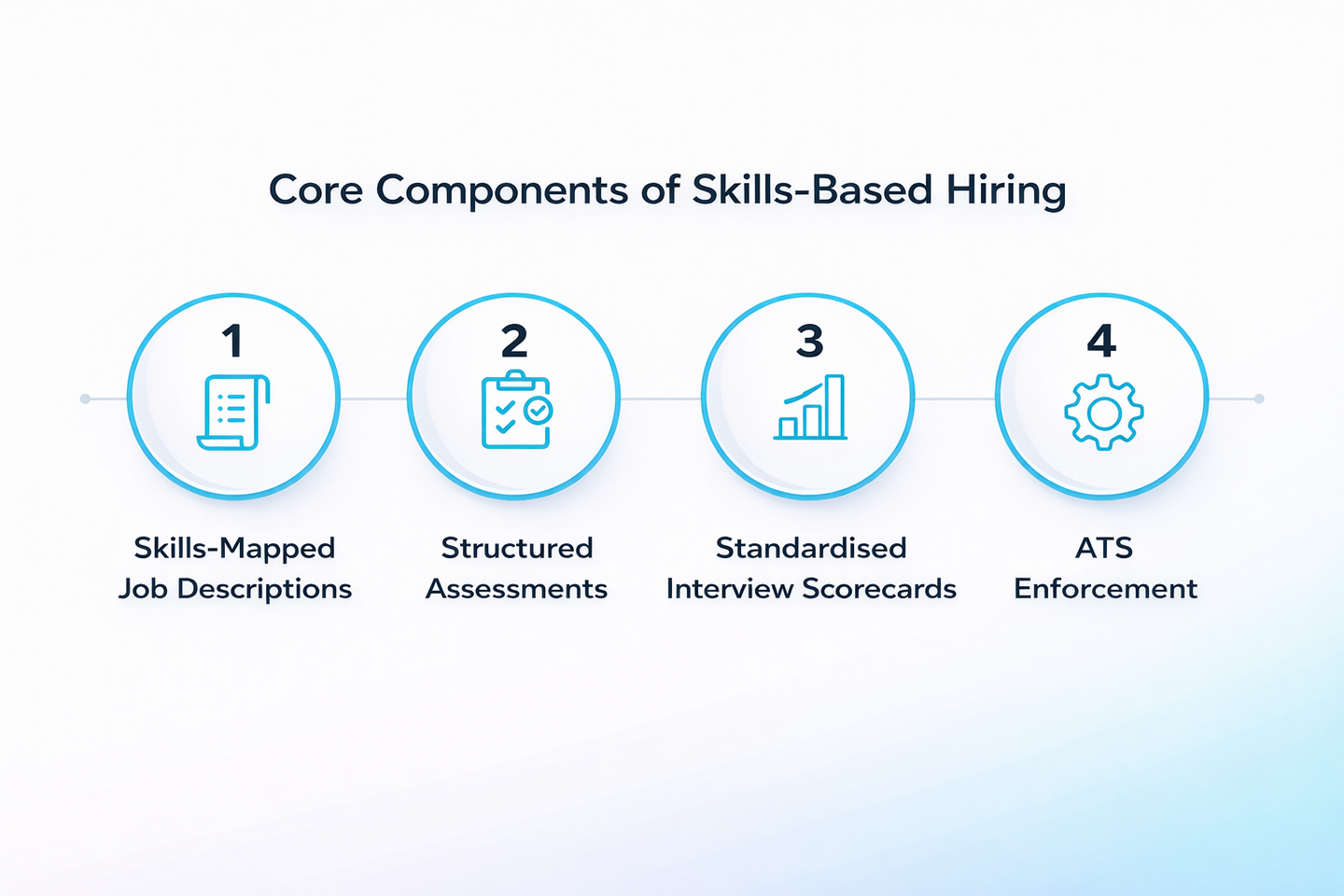
A skills-based hiring process has four core components: skills-mapped job descriptions, structured assessments, standardised interview scorecards, and an ATS that enforces consistency across every stage.
Each component addresses a specific failure point in traditional hiring:
- Skills-mapped job descriptions replace vague requirements like "Bachelor's degree preferred" with specific, testable criteria such as "Proficiency in SQL and experience building dashboards in Tableau or equivalent tools." This is the entry point for the entire process, because if the job description does not reflect skills, nothing downstream will either.
- Structured assessments give candidates the opportunity to demonstrate relevant abilities through work samples, situational judgment tests, or task-based exercises. These provide objective data points that complement interview impressions.
- Standardised interview scorecards ensure that every interviewer evaluates candidates against the same competencies using the same rating scale. Without scorecards, interview feedback tends to default to subjective impressions and gut feelings. In 2024, SHRM found that 54% of organisations use pre-employment assessments to gauge applicants' knowledge, skills, and abilities, with 78% reporting that these assessments improved the quality of their hires.
- An ATS that enforces the process is what ties everything together. Without system-level enforcement, even well-designed skills-based processes tend to revert to ad-hoc interviewing within weeks. The ATS should embed evaluation templates, automate scheduling, and surface analytics that reveal whether the process is actually working.
These four components are interdependent. Updating job descriptions without changing the interview process, or designing scorecards without an ATS that can deliver them to interviewers, produces only partial results.
How Do You Implement Skills-Based Hiring Step by Step?
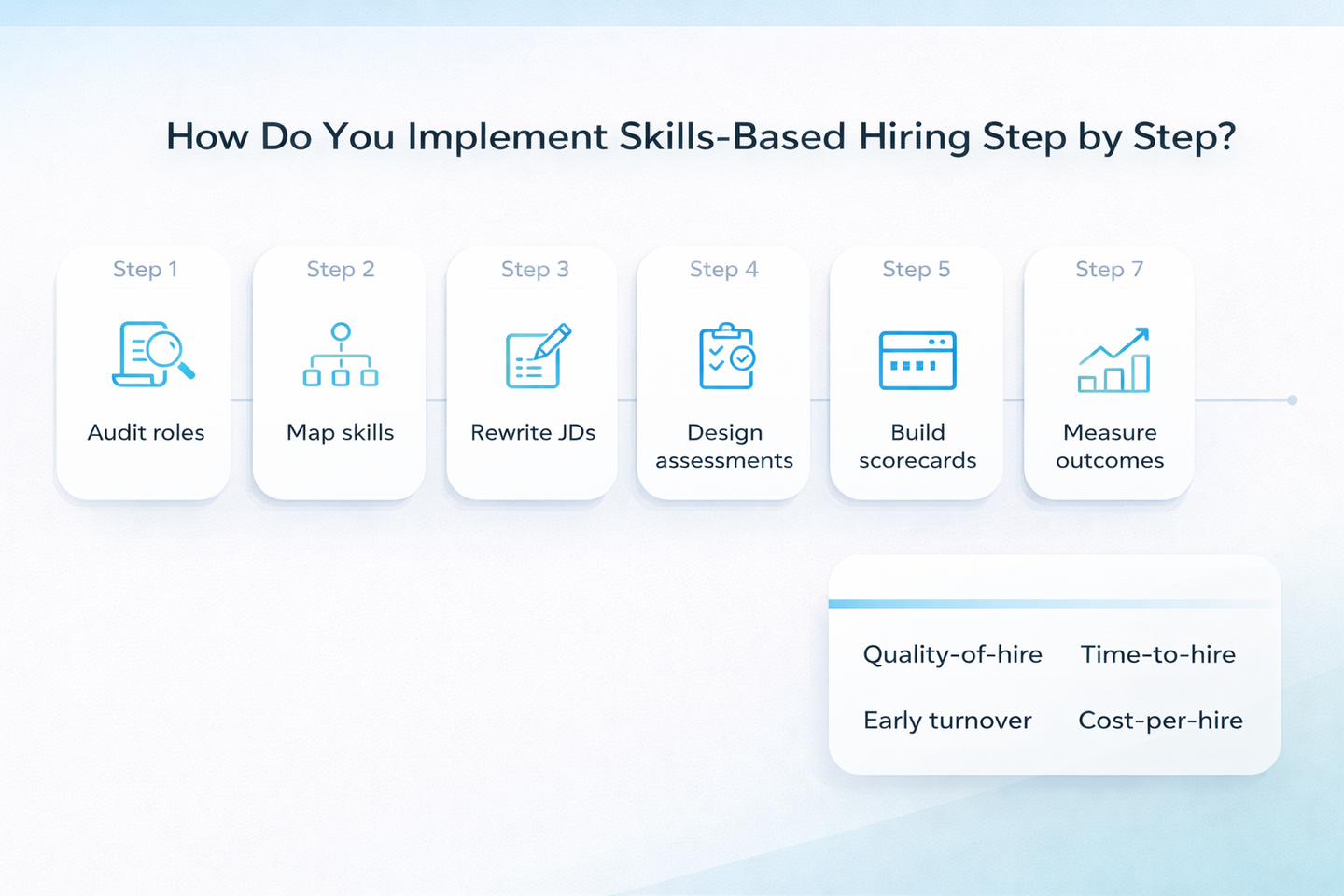
Implementation follows seven steps: audit current roles, map required skills, rewrite job descriptions, design assessments, build structured scorecards, configure your ATS, and measure outcomes. Each step builds on the one before it, and skipping stages is one of the most common reasons implementations stall.
Step 1: Audit Your Current Roles and Identify Skills Gaps
Start by reviewing your existing job descriptions and separating genuine skill requirements from inherited assumptions. Many roles carry degree requirements that were added years ago and never revisited.
For each open or recurring role, categorise the requirements into three buckets: core skills (essential on day one), adjacent skills (enhance performance but are not strictly required), and learnable skills (can be developed through onboarding or training). This audit typically reveals that a significant portion of listed requirements are learnable rather than core, meaning they should not be used as screening filters.
Step 2: Create a Skills Taxonomy for Each Role
Once you have audited existing roles, build a structured skills taxonomy that maps the specific competencies needed for each position. This should include both technical skills (such as programming languages, tools, or certifications) and transferable skills (such as problem-solving, communication, or project coordination).
The most effective taxonomies are built collaboratively. Involve hiring managers and current high-performers in the mapping process, as they can identify which skills actually drive success in the role versus which ones merely look good on paper. Keep the taxonomy focused: three to five core competencies per role is a practical ceiling. More than that dilutes evaluator focus and makes scoring cumbersome.
Step 3: Rewrite Job Descriptions Around Skills
With your skills taxonomy in hand, rewrite job descriptions to centre on capabilities rather than credentials. This is where the shift becomes visible to candidates.
Before (traditional):
"Requirements: Bachelor's degree in Marketing or related field. Minimum 5 years of experience in a similar role. Strong communication skills."
After (skills-based):
"What you'll need: Demonstrated experience running multi-channel campaigns using tools like HubSpot, Google Ads, or equivalent platforms. Ability to analyse campaign performance data and translate insights into actionable recommendations. Strong written communication, evidenced by portfolio samples or past work."
The revised version is specific, testable, and does not exclude candidates who developed their skills through non-traditional pathways.
Step 4: Design Skills Assessments for Each Stage
Assessments should be matched to the hiring stage. At the screening stage, short task-based exercises or situational judgment tests help filter a large applicant pool without consuming excessive interviewer time. At the final stage, deeper work samples or case-based exercises provide richer data on a candidate's ability to perform in the actual role.
The key is that assessments must mirror real job demands. A marketing role might require candidates to draft a brief campaign plan. An engineering role might involve a short coding challenge. An operations role might present a logistics scenario to solve. Generic personality tests or abstract puzzles add noise without predictive value.
Step 5: Build Structured Interview Scorecards
Structured interview scorecards are the mechanism that converts skills-based hiring from an aspiration into a repeatable system. Each scorecard should list three to five key competencies, define what a strong response looks like at each rating level, and include behavioural or situational questions designed to surface evidence of those competencies.
Example scoring rubric for "Problem-Solving" (1 to 5 scale):
- Score 1: Below expectations
- Definition: Candidate cannot articulate a structured approach to problem-solving and provides vague or unrelated examples.
- What this indicates: The candidate has not shown enough evidence of a repeatable problem-solving method.
- Score 2: Partially meets
- Definition: Candidate describes a basic approach but lacks depth; examples are limited in scope or relevance.
- What this indicates: The candidate may understand the concept of problem-solving but has not demonstrated enough practical or role-relevant evidence.
- Score 3: Meets expectations
- Definition: Candidate demonstrates a clear, logical approach with a relevant example; identifies root causes and considers trade-offs.
- What this indicates: The candidate has shown a suitable level of structured problem-solving for the role.
- Score 4: Exceeds expectations
- Definition: Candidate provides a strong example with measurable outcomes and shows ability to adapt their approach based on constraints.
- What this indicates: The candidate can apply problem-solving skills effectively in real situations and adjust their thinking when conditions change.
- Score 5: Exceptional
- Definition: Candidate demonstrates sophisticated, systematic problem-solving across multiple examples, with evidence of impact at team or organisational level.
- What this indicates: The candidate shows advanced problem-solving ability and can create wider value beyond an individual task.
This kind of rubric ensures that a score of "4" means the same thing regardless of which interviewer assigns it. For a detailed guide on building and using structured interview scorecards with an ATS, see our article on mastering structured interviews with an applicant tracking system.
Step 6: Configure Your ATS to Enforce the Process
This is where many implementations break down. Even with well-designed scorecards and assessments, the process only holds if the ATS actively delivers evaluation criteria to interviewers, tracks completion, and flags inconsistencies.
At a minimum, your ATS configuration should include evaluation templates linked to each role, automated interview scheduling that reduces administrative delays, and mandatory scorecard submission before a candidate can advance to the next stage. Wantedly Hire, for example, provides customisable evaluation criteria and structured interview templates for 12 or more job categories, along with multi-interviewer scheduling that automatically finds available time slots using AND/OR logic across calendars.
The goal is to make the structured process the path of least resistance, so interviewers do not need to remember to follow it. The ATS should do the enforcing.
Step 7: Measure, Iterate, and Report
Skills-based hiring is not a one-time project. After launch, track key metrics to understand whether the new process is producing better outcomes than the old one. The four metrics that matter most are quality-of-hire (performance ratings of new hires), time-to-hire, early turnover rate (within the first 12 months), and cost-per-hire by source.
In 2025, TestGorilla's annual report found that 90% of companies using skills-based hiring reduced mishires, although satisfaction levels have shown a slight year-over-year decline, suggesting that implementation quality matters as much as adoption. Measurement is what separates organisations that sustain this approach from those that abandon it after one quarter.
Use your ATS analytics to run funnel conversion reports, identify stages with high drop-off rates, and correlate interviewer scores with post-hire performance. Wantedly Hire's advanced reporting features allow you to track source-level performance, rejection reasons, and pipeline velocity without needing to export data into spreadsheets.
Ready to configure skills-based workflows in your ATS? Request a Wantedly Hire demo
What Should You Look for in an ATS That Supports Skills-Based Hiring?
An ATS built for skills-based hiring must do more than store applications. It should help hiring teams assess candidates against the same role-specific competencies, keep interviews structured, and turn hiring data into decisions that can be measured and improved.
Start with the evaluation workflow. The ATS should support customisable evaluation forms with per-stage and per-role templates, rating scales, and mandatory fields so interviewers assess candidates consistently. It should also include structured interview scorecards, either pre-built or customisable, with sample criteria libraries that make it easier to compare candidates fairly and reduce subjective bias.
Next, look at how well the system supports the hiring process itself. Automated interview scheduling is important because it reduces delays and candidate drop-off, especially when the ATS offers multi-interviewer AND/OR calendar sync and candidate self-scheduling links. Flexible workflow design also matters because different roles may need different assessment stages. A strong ATS should allow drag-and-drop pipeline customisation and multi-action steps, such as combining a task and interview within one stage.
Finally, assess whether the ATS gives hiring teams useful data. Advanced analytics should show source-level performance, funnel conversion rates, rejection reasons, and withdrawal reasons, while application source tracking should connect hiring quality back to specific sourcing channels through custom source labels and ROI-per-source analysis. Candidate data should also be centralised, with profile views, evaluation history, and communication logs kept in one place so hiring teams have a complete record before making decisions.
Many legacy ATS platforms were built primarily for applicant tracking, not structured evaluation. They often fall short on customisable evaluation forms and advanced analytics, which are the two capabilities most critical to sustaining a skills-based process. If your current system cannot embed evaluation criteria directly into the interview workflow, interviewers are unlikely to use them consistently.
For a comparison of ATS options in the Singapore market, see our overview of what makes the best ATS for SMEs in Singapore.
How Do Structured Interviews Fit Into Skills-Based Hiring?
Structured interviews are the backbone of skills-based hiring. They use standardised questions, rating rubrics, and pre-defined evaluation criteria so every candidate is assessed on the same competencies, making hiring decisions more predictive and less biased.
The distinction from unstructured interviews is critical. In an unstructured interview, the conversation follows the interviewer's instincts, which means two candidates for the same role may be evaluated on entirely different criteria depending on who interviews them. In a structured interview, questions are pre-selected to map to the role's key competencies, responses are scored against a defined rubric, and the process is consistent regardless of which interviewer conducts it.
To make structured interviews operational at scale, your ATS needs to deliver the right questions and scorecards to the right interviewer at the right stage, without requiring manual coordination. Wantedly Hire ships with structured interview templates covering more than 12 job categories, from engineering to executive roles, along with sample evaluation criteria that teams can customise or use directly. This reduces the setup time from weeks to days, which is particularly valuable for mid-market companies that do not have dedicated talent operations teams.
A practical approach is to start with one high-volume role, implement structured interviews for that role, measure the results over two to three hiring cycles, and then expand to other positions based on what you learn.
Wantedly Hire ships with structured interview templates for 12+ roles, from engineering to executive. See how it works
What Are the Biggest Mistakes When Implementing Skills-Based Hiring?
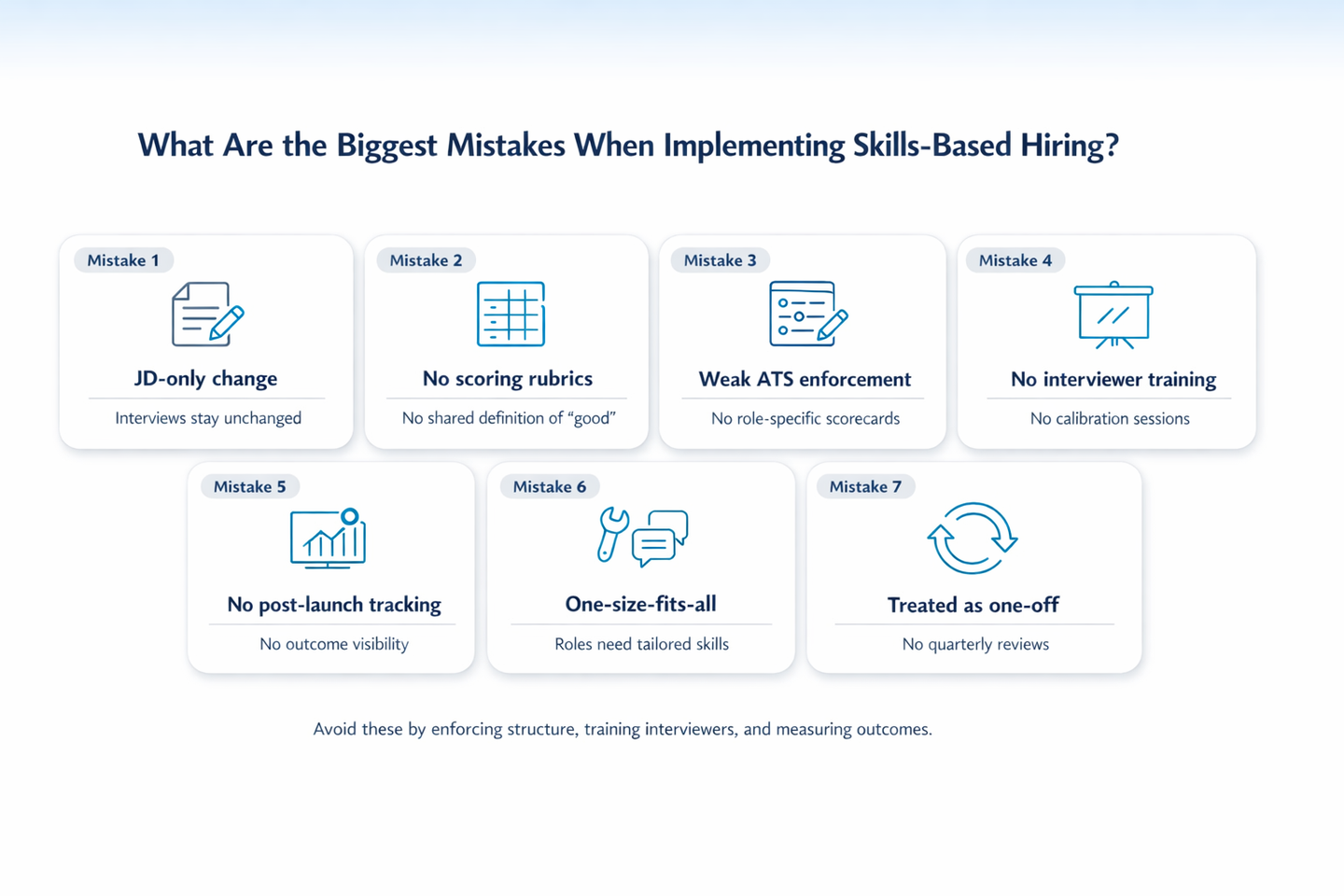
The most common mistakes are treating skills-based hiring as a job description rewrite alone, failing to train interviewers on structured evaluation, choosing an ATS that cannot enforce standardised processes, and not measuring outcomes post-implementation.
Here are the seven pitfalls that most frequently derail implementation, along with how to avoid each one.
1. Only updating job descriptions without changing the interview process. Removing degree requirements from job posts is a visible and easy first step, but it achieves little if interviewers continue to evaluate candidates based on credentials and gut feel. The interview process, not just the job description, must change. A 2024 study by Harvard Business School and the Burning Glass Institute found that even among companies that eliminated degree requirements, actual hiring behaviour often remained unchanged.
2. Not defining clear scoring rubrics before going live. Without rubrics, structured interviews are structured in name only. Interviewers need to know exactly what a "strong" versus "adequate" response looks like for each competency. Define rubrics before the first interview, not after.
3. Using an ATS that lacks customisable evaluation forms. If your ATS cannot deliver role-specific scorecards to interviewers within the interview workflow, compliance will be low. The tool must make structure the default, not an optional add-on.
4. Skipping interviewer training and calibration sessions. Even experienced interviewers need training on how to score against a rubric and how to avoid anchoring on irrelevant factors. Calibration sessions, where multiple interviewers score the same recorded response and compare their ratings, are one of the most effective ways to build consistency.
5. Ignoring analytics after launch. If you do not track quality-of-hire, time-to-hire, or early turnover before and after implementation, you have no way to know whether the new process is working. Measurement is not optional; it is the feedback loop that drives improvement.
6. Applying the same process to every role without tailoring. A software engineering role and a customer success role require different competencies, different assessments, and different scorecards. A one-size-fits-all approach undermines the precision that makes skills-based hiring effective.
7. Treating implementation as a one-time project. Skills-based hiring is a system, not a project with a start and end date. Roles evolve, skill requirements shift, and hiring teams change. Build in quarterly reviews of your scorecards, assessments, and pipeline data to keep the process current.
How Do You Measure the ROI of Skills-Based Hiring?
Measure ROI by tracking four key metrics before and after implementation: quality-of-hire, time-to-hire, early turnover rate (within the first 12 months), and cost-per-hire by source.
Quality-of-hire is the most important but also the hardest to measure. Compare performance ratings, ramp-up time, and manager satisfaction scores for hires made through the new process against a baseline from prior hires. Even directional improvements here justify the investment.
Time-to-hire often improves because structured processes reduce back-and-forth deliberation. When interviewers have clear criteria and a rubric, decisions happen faster. In 2024, a report found that the largest group of employer respondents reduced their time-to-hire by 26 to 50% after switching to skills-based hiring.
Early turnover rate is a strong signal of hiring quality. Candidates who are well-matched to the actual demands of a role, rather than simply holding the right credential, are more likely to stay. LinkedIn data has shown that employees hired without traditional degrees tend to stay in their roles 34% longer than those with degrees.
Cost-per-hire by source reveals which channels produce candidates who perform well through skills-based evaluation. Your ATS should allow you to tag application sources and then correlate source with downstream outcomes like offer acceptance rate and post-hire performance.
To calculate meaningful ROI, establish baseline measurements for all four metrics before launching the new process. Then compare at 90-day and 180-day intervals. Even modest improvements across multiple metrics compound into significant value, particularly for organisations hiring at volume.
Skills-Based Hiring Implementation Checklist for APAC Teams
Use this checklist to track your progress across the seven implementation stages. It incorporates APAC-specific considerations that teams in the region should account for.
Phase 1: Foundation
[ ] Audit all active job descriptions; flag roles with unnecessary degree requirements
[ ] Identify the top 2 to 3 roles for a pilot programme (choose high-volume or high-turnover roles)
[ ] Assemble a cross-functional implementation team (HR, hiring managers, one executive sponsor)
Phase 2: Design
[ ] Build a skills taxonomy for each pilot role (3 to 5 core competencies per role)
[ ] Rewrite pilot job descriptions to centre on skills, not credentials
[ ] Design stage-appropriate assessments (screening-stage tasks and final-stage work samples)
[ ] Create structured interview scorecards with defined rubrics for each competency
[ ] Account for APAC-specific factors: multilingual assessment needs, regional credential variation, cultural interview norms (e.g., indirect communication styles)
Phase 3: Configure
[ ] Set up evaluation templates in your ATS, linked to each pilot role
[ ] Enable automated interview scheduling with multi-interviewer calendar sync
[ ] Configure mandatory scorecard submission before candidates can advance stages
[ ] Set up application source tracking with custom labels for each channel
Phase 4: Launch and Train
[ ] Conduct interviewer training sessions on scorecard usage and bias avoidance
[ ] Run at least one calibration session before the first live interview
[ ] Go live with the pilot roles
Phase 5: Measure and Expand
[ ] Track quality-of-hire, time-to-hire, early turnover, and cost-per-hire by source
[ ] Review pipeline analytics at 90-day intervals
[ ] Refine scorecards and assessments based on data
[ ] Expand to additional roles based on pilot results
[ ] Schedule quarterly reviews of the entire process
How Does Wantedly Hire Support Skills-Based Hiring?
Wantedly Hire is a next-generation ATS designed for structured, skills-based recruitment, with customisable evaluation criteria, automated scheduling, structured interview templates for more than 12 job categories, and advanced analytics built in.
What makes Wantedly Hire particularly well suited for skills-based hiring is its design philosophy: the system was built to make structured processes the default rather than the exception. Key capabilities include:
- Customisable evaluation criteria and scorecards that can be tailored per role and per interview stage, with sample data for 12 or more job categories including engineering, product management, sales, and executive roles
- Multi-action interview steps that allow teams to combine different activities (such as a task-based exercise and a structured interview) within a single pipeline stage
- Automated multi-interviewer scheduling using AND/OR logic across calendars, reducing scheduling time by up to 80%
- Advanced analytics and reporting with configurable filters, funnel conversion tracking, and rejection-reason analysis, all accessible within the platform without CSV exports
- Source-level performance tracking that connects application channels to downstream hiring outcomes
Wantedly Hire integrates with Google Workspace and Slack, and setup typically takes just a few business days. For companies already using another ATS, Wantedly Hire supports CSV import of candidate and job post data for straightforward migration.
To see how organisations are already using Wantedly Hire to build structured hiring processes, read about how CTS APAC set up local hiring processes and hired their first tech talent.
See how Wantedly Hire can power your skills-based hiring transformation. Request a free demo
Frequently Asked Questions
What is the difference between skills-based hiring and competency-based hiring?
Skills-based hiring evaluates candidates on specific, measurable abilities such as SQL proficiency or campaign management. Competency-based hiring is broader, encompassing behaviours, traits, and knowledge areas like "strategic thinking" or "leadership." In practice, many organisations use both terms interchangeably, but skills-based hiring tends to focus on more directly testable, role-specific capabilities.
How long does it take to implement skills-based hiring?
A pilot programme for a single role can be designed in two to four weeks. Full organisational rollout typically takes several months, depending on the number of roles, interviewer training needs, and ATS configuration complexity. Starting with a small group of high-volume roles is a common and effective approach.
Can skills-based hiring work for senior or executive roles?
Yes. Structured evaluation of leadership competencies, strategic decision-making, and stakeholder management skills is just as applicable at senior levels. Modern ATS platforms, including Wantedly Hire, provide evaluation templates for executive-level hiring that can be customised to match the specific demands of each leadership position.
Do I need to remove all degree requirements to adopt skills-based hiring?
Not necessarily. Skills-based hiring means making skills the primary evaluation criterion, not eliminating degrees entirely. For roles where a specific qualification is legally or technically required (such as medical or legal positions), it should remain. The key shift is to stop using degrees as a proxy for ability when direct skills assessment is possible.
What role does an ATS play in skills-based hiring?
An ATS enforces consistency by embedding structured evaluation criteria, scorecards, and standardised workflows into every hiring pipeline. Without ATS support, skills-based processes tend to revert to ad-hoc interviewing within weeks. Look for an ATS with customisable evaluation forms, structured interview templates, and advanced analytics.
How does skills-based hiring reduce bias in recruitment?
By standardising the criteria, questions, and rating scales used to evaluate every candidate, skills-based hiring reduces the influence of subjective factors like educational prestige, personal rapport, or unconscious demographic bias. In 2024, SHRM reported that 73% of organisations that eliminated degree requirements for certain positions found at least one new hire they would have previously considered unqualified for the role.
Is skills-based hiring relevant in Asia-Pacific markets?
Highly relevant. A LinkedIn survey found that 79% of APAC companies prioritise skills and competencies over qualifications when hiring. Acute talent shortages in sectors like technology, combined with demographic shifts in markets like Japan, are accelerating adoption. The approach is particularly valuable in multilingual, multicultural hiring environments where credentials vary widely across education systems.
Wantedly Hire is an application tracking system optimised for modern hiring practices. Experience seamless hiring with tailored workflows designed to align with your recruitment structure, automated interview scheduling, and actionable insights to optimise hiring performance!
Sign up for a demo and enjoy a limited-time discount on your subscription.
/assets/images/7053115/original/43c7433b-4920-4cf1-b0b0-c44aec7bd947?1624242511)


)/assets/images/7053115/original/43c7433b-4920-4cf1-b0b0-c44aec7bd947?1624242511)


/assets/images/21128915/original/43c7433b-4920-4cf1-b0b0-c44aec7bd947?1747371924)