
Complete Implementation Checklist: Applicant Tracking System for Singapore Small and Medium Enterprises
Singapore added 57,300 jobs in 2025, a clear increase from 44,500 the year prior. Yet an SNEF survey of 240 employers found that 58% plan to freeze hiring in 2026, up from 50% in 2024. The signal is clear: every hire now needs to count, and SMEs cannot afford to lose candidates to slow, manual processes.
For SMEs still relying on spreadsheets, email inboxes, and WhatsApp threads to manage recruitment, this gap between hiring pressure and operational capability is growing. This guide provides a complete, step-by-step checklist for choosing, setting up, and optimising an Applicant Tracking System (ATS) built for SME-scale hiring in Singapore.
Quick Summary: What This Checklist Covers
This checklist covers the end-to-end ATS implementation journey for Singapore SMEs in seven phases: readiness assessment, feature evaluation, vendor selection, data migration, workflow configuration, team onboarding, and post-launch optimisation.
An Applicant Tracking System (ATS) is recruitment software that centralises job postings, candidate tracking, interview scheduling, and hiring analytics in one platform. Singapore SMEs should implement an ATS when manual hiring takes more than five hours per week or open roles exceed three simultaneously. Key selection criteria include PDPA-compliant data handling, automated scheduling, structured interview support, and scalable reporting. Budget for onboarding time of one to two weeks for most modern platforms.
Each section below maps to a specific phase. Use it as a sequential guide or jump to the phase most relevant to where you are right now. When you are ready to see these phases in action, book a free demo of Wantedly Hire.
What Is an ATS and Why Do Singapore SMEs Need One in 2026?
An ATS is recruitment software that automates and centralises every hiring step, from posting jobs to onboarding new hires, in a single dashboard. For Singapore SMEs facing rising manpower costs and tighter foreign-talent thresholds, an ATS replaces fragmented manual processes with structured, data-driven hiring.
SMEs make up 99% of all enterprises in Singapore and employ roughly 70% of the local workforce. Despite their outsized role in the economy, many still manage recruitment through disconnected tools that make it difficult to track candidate progress or maintain a consistent hiring experience.
The 2026 labour market adds urgency. In its 2025 survey, the Singapore National Employers Federation (SNEF) found that 79% of employers cite rising manpower costs as their top challenge, while 47% struggle to attract and retain professionals, managers, executives, and technicians. Smaller employers are feeling this even more acutely, with 63% indicating they are likely to halt new hires altogether in 2026.
At the same time, foreign talent thresholds are rising. From 1 January 2026, the minimum qualifying salary for Employment Pass renewals increased to S$5,600 for most sectors and S$6,200 for financial services. This pushes total manpower costs higher, making it essential for SMEs to get the most out of every recruitment dollar spent.
Singapore's Personal Data Protection Act (PDPA) also applies to any system that stores candidate personal data, including names, contact details, resumes, and interview notes. An ATS helps SMEs meet these obligations by centralising consent tracking, enforcing role-based access, and maintaining audit trails, rather than leaving candidate data scattered across personal email accounts and chat groups.
For a deeper look at how an ATS fits into a modern SME recruitment workflow, see our guide on how to streamline the recruitment process for SMEs.
How Do You Know Your SME Is Ready for an ATS?
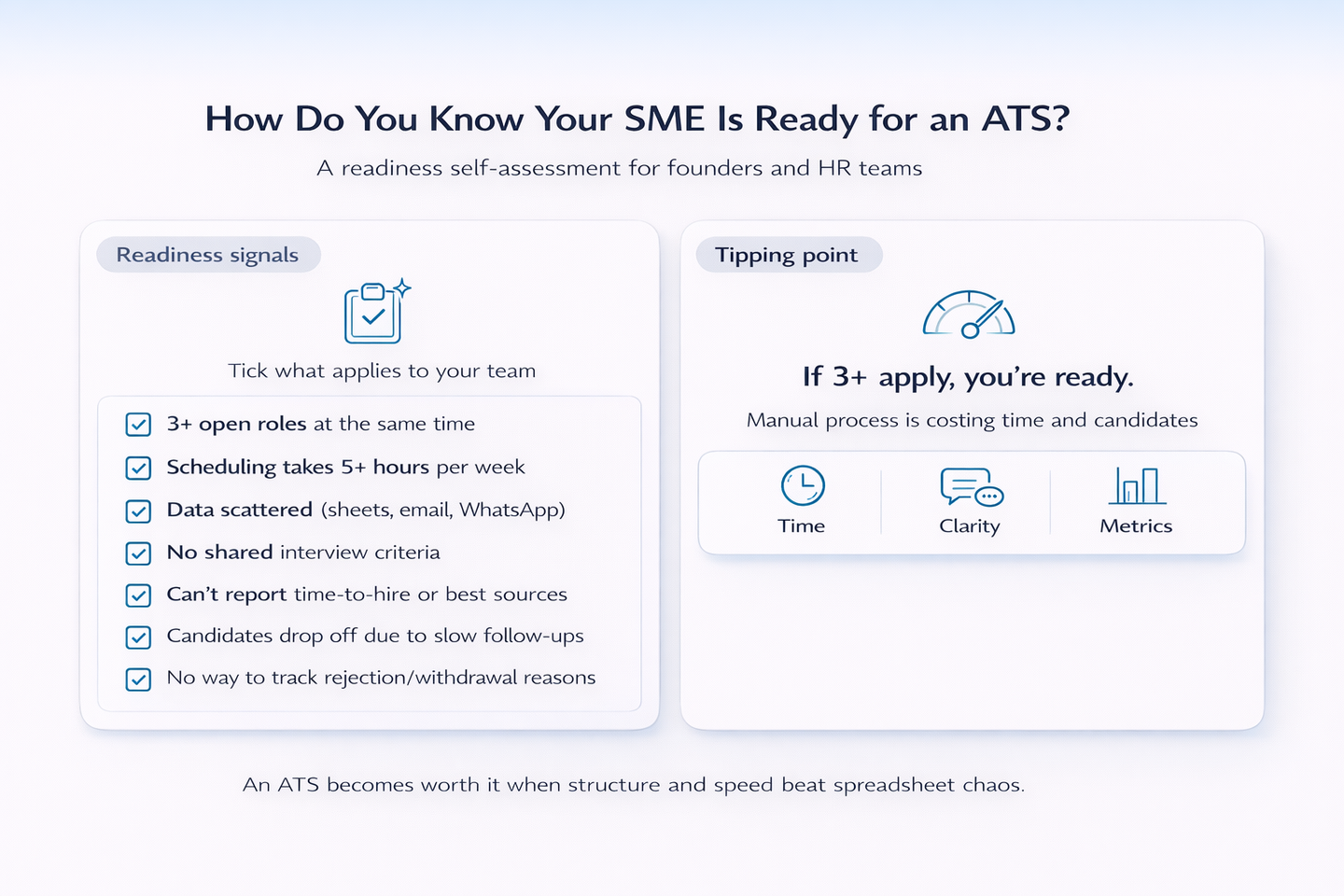
Your SME is ready for an ATS when manual hiring consumes disproportionate time, candidate experience suffers from slow follow-ups, or you cannot report on basic metrics like time-to-hire and source effectiveness.
Many SME founders and HR executives assume they are "too small" for an ATS. In practice, the tipping point arrives earlier than expected. If any of the following signals apply to your business, you are likely already losing time and candidates to process gaps.
Readiness self-assessment: check the signals that apply.
- You are managing three or more open roles at the same time
- Scheduling interviews takes more than five hours per week
- Candidate data lives across spreadsheets, emails, and WhatsApp groups with no single source of truth
- Interviewers evaluate candidates using different criteria or no standard framework at all
- You cannot answer "what is our average time-to-hire?" or "which source brings our best candidates?"
- Candidates frequently drop off mid-process because of slow follow-ups
- You have no structured way to track why candidates are rejected or why they withdraw
If three or more of these apply, your manual process is likely costing you more than an ATS subscription would. CTS APAC faced exactly this challenge when hiring their first specialised tech role with no local HR resources. After implementing Wantedly Hire, they were able to establish a recruitment strategy, build a talent pipeline, and localise their hiring process through a structured ATS workflow.
What Features Should Singapore SMEs Prioritise in an ATS?
Singapore SMEs should prioritise five core capabilities: automated interview scheduling, customisable hiring workflows, structured interview tools, source-level analytics, and PDPA-compliant candidate data management.
Not every feature matters equally when your team is small and your budget is tight. The matrix below separates must-have capabilities from nice-to-have and future-proof features, with each feature mapped directly to an SME pain point it resolves.
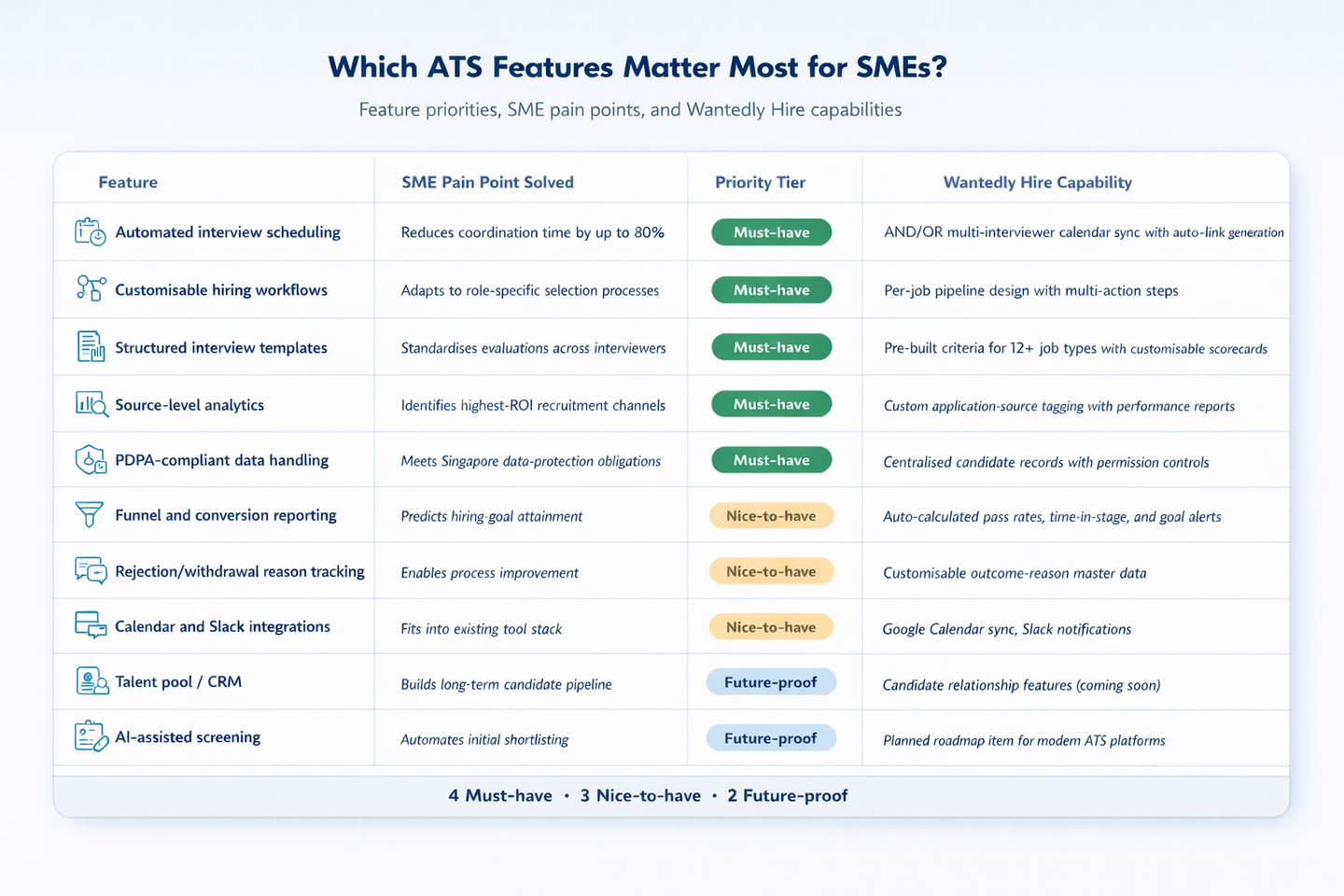
When evaluating vendors, use this matrix as a scoring checklist. Any ATS that does not cover the "Must-have" tier will leave critical gaps in your hiring process. For a walkthrough of how these features work in practice, explore the full feature overview of Wantedly Hire.
Step-by-Step ATS Implementation Checklist for Singapore SMEs
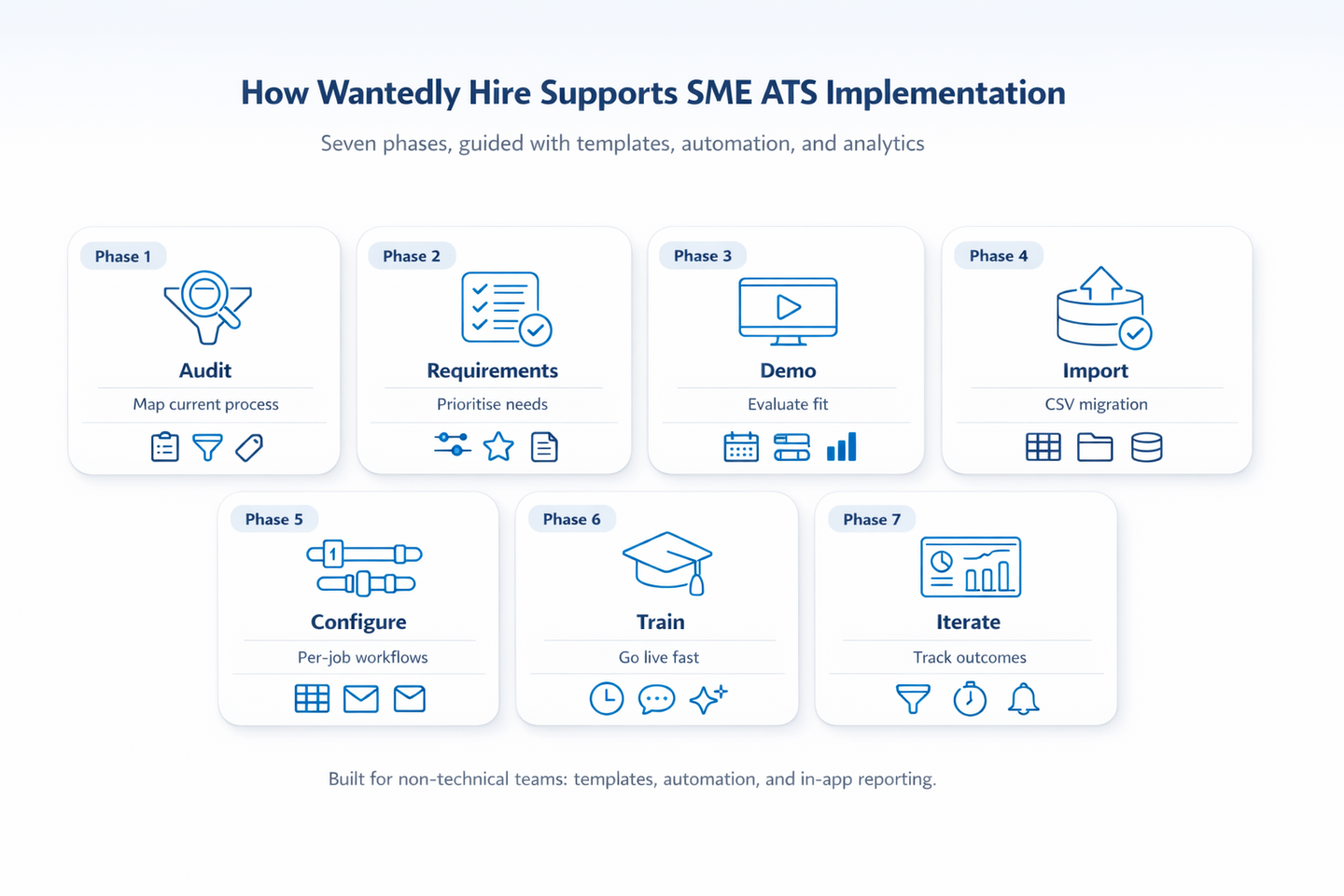
A successful ATS implementation follows seven phases over roughly four to six weeks: audit your current process, define requirements, evaluate vendors, migrate data, configure workflows, train your team, and launch with a pilot role.
The phases below are designed for SME-scale teams, typically two to ten hiring stakeholders, and assume no dedicated IT department. Each phase includes specific action items you can assign and track.
Phase 1: Audit Your Current Hiring Process (Week 1)
Before selecting any tool, document exactly how hiring works today. This audit prevents the most common implementation mistake: digitising a broken process.
- Map every touchpoint from job posting to offer acceptance, noting who is responsible at each stage
- Record how much time each activity takes per week (scheduling, screening, follow-ups, feedback collection)
- List all tools currently in use, including spreadsheets, email threads, WhatsApp groups, and job-board dashboards
- Identify where delays happen most frequently and where candidates typically drop off
This baseline becomes your "before" measurement. Without it, you will have no way to quantify the improvement your ATS delivers after launch.
Phase 2: Define Requirements and Success Metrics (Week 1)
With your audit complete, translate the pain points into measurable goals and feature requirements.
- Set three to five measurable objectives, such as reducing time-to-hire by a specific number of days, centralising all candidate data, or achieving 100% interviewer-evaluation completion
- Prioritise features using the matrix in the previous section, separating must-haves from nice-to-haves
- Confirm who will own the ATS internally, typically the HR lead or a designated hiring coordinator
Phase 3: Evaluate and Select Your ATS Vendor (Week 2)
Shortlist two to three vendors and request demos. Score each vendor against your requirements matrix from Phase 2.
- Verify PDPA compliance features: consent tracking, role-based access, data retention controls, and audit trails
- Confirm Singapore-based support availability and onboarding assistance
- Check integration with your existing tools, especially calendar applications and communication platforms like Slack
- Ask about data migration support: can you import candidate records via CSV from your current system?
- Review pricing transparency, specifically whether costs scale predictably as your team and hiring volume grow
Phase 4: Migrate Existing Candidate Data (Week 2 to 3)
Data migration is often the step SMEs underestimate. A clean migration prevents duplicates and gaps from day one.
- Export data from your current tools (spreadsheets, job-board dashboards, email folders) into CSV format
- Clean and deduplicate records before import, removing outdated entries, incomplete profiles, and duplicate contacts
- Map your existing data fields to the new ATS structure, ensuring candidate names, contact details, application sources, and interview notes transfer correctly
Wantedly Hire supports CSV uploads for candidate and job-post data, making it possible to move active records into the system with minimal manual effort.
Phase 5: Configure Workflows and Templates (Week 3)
This is where your ATS starts reflecting how your business actually hires. Invest time here to avoid rework later.
- Build role-specific hiring pipelines, mapping each stage from application to offer
- Set up evaluation criteria and interview scorecards. Wantedly Hire includes pre-built structured interview templates for 12+ job types, so you do not need to start from scratch
- Create email and notification templates for common candidate touchpoints: application acknowledgement, interview confirmation, stage progression, and rejection
- Configure application-source labels so you can track where candidates come from (job boards, referrals, direct applications, scouts)
- Set up rejection and withdrawal reason categories to enable future process analysis
Phase 6: Train Your Hiring Team (Week 4)
Training is not just for HR. Hiring managers need to understand the system too, or adoption will stall.
- Run a hands-on training session covering the end-to-end candidate workflow. Most SME teams using Wantedly Hire complete onboarding within one week
- Assign roles and permissions: recruiter, hiring manager, and executive viewer each need different levels of access
- Establish internal SLAs for response times, such as acknowledging candidate applications within 24 hours and submitting interview evaluations within 48 hours
- Document a short "quick start guide" for your team so new users can self-serve basic tasks without waiting for help
Phase 7: Launch with a Pilot Role and Iterate (Week 4 to 6)
Avoid a big-bang rollout. Start with one live role and use it to test and refine your configuration before scaling.
- Open one active job through the ATS end-to-end: posting, screening, scheduling, interviewing, evaluating, and offering
- Collect structured feedback from the hiring manager and, where appropriate, from candidates about their experience
- Review the data: did interview scheduling actually speed up? Were all evaluations submitted on time? Did any stage create unexpected friction?
- Adjust workflows, templates, and permissions based on what you learned before rolling out to all open positions
Ready to start your ATS implementation? Book a free demo of Wantedly Hire and see how our platform supports each phase of this checklist.
How Much Does an ATS Cost for a Singapore SME?
ATS pricing for Singapore SMEs typically follows a per-user or per-job monthly subscription model, with entry-level plans starting in the low single-digit SGD per user per month range for basic platforms. Wantedly Hire offers subscription plans scaled to SME needs, so the best way to get a tailored quote is to contact the team directly.
Three common pricing models exist across the market.
Per-user/month charges a flat fee for each team member who accesses the system. This works well for SMEs with a small, stable hiring team. Per-job/month charges based on the number of active job postings, suiting businesses with fluctuating hiring volumes. Flat platform fee provides full access for a fixed monthly or annual price, regardless of users or jobs. This model is the most predictable for budgeting.
When evaluating cost, factor in what you are currently spending on manual hiring. Consider recruiter hours lost to scheduling, the cost of a prolonged vacancy, and the price of a bad hire caused by inconsistent evaluation. These hidden costs frequently exceed the ATS subscription many times over.
How Do You Ensure PDPA Compliance When Using an ATS?
To stay PDPA-compliant, your ATS must support purpose-limited data collection, obtain candidate consent before storing personal data, provide access and correction mechanisms, and enforce data retention policies.
Singapore's Personal Data Protection Act (PDPA) applies to any organisation that collects, uses, or discloses personal data of individuals in Singapore, regardless of the organisation's size. For recruitment, this covers candidate names, contact details, resumes, interview notes, and evaluation scores.
Five key PDPA obligations apply directly to recruitment data handling:
- Consent obligation. Obtain clear consent from candidates before collecting and storing their personal data. An ATS should allow you to embed consent collection into the application flow.
- Purpose limitation. Collect only what is necessary at each recruitment stage. Asking for financial details or full medical history during initial screening, for example, is excessive and has resulted in enforcement action.
- Access and correction. Candidates have the right to request access to their data and ask for corrections. Your ATS should make it straightforward to retrieve and update candidate records.
- Retention limitation. Once a hiring decision is made, personal data of unsuccessful candidates should only be retained for as long as there is a legitimate business or legal purpose. Configure your ATS to flag records that have exceeded your retention policy.
- Protection obligation. Implement role-based access controls, encryption, and audit trails to prevent unauthorised access. Avoid storing candidate data in personal email accounts or unprotected shared drives.
The most common compliance gaps among SMEs are not technical; they are procedural. Storing CVs in personal inboxes, sharing candidate details via WhatsApp without consent, and keeping rejected candidate data indefinitely are all common practices that create regulatory risk. An ATS with built-in compliance features addresses these gaps from day one.
What Are the Biggest ATS Implementation Mistakes Singapore SMEs Make?
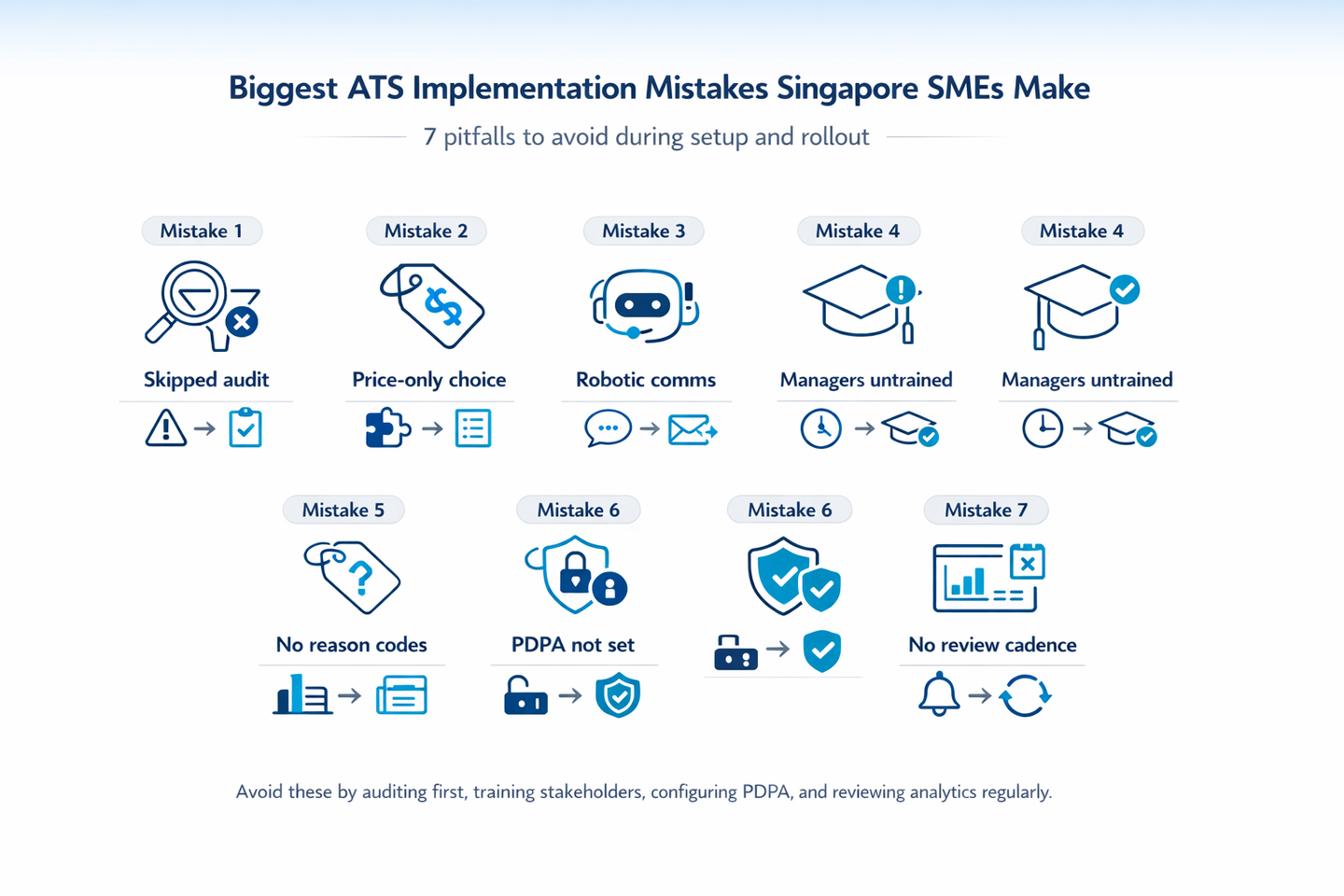
The most common ATS implementation mistakes among Singapore SMEs are skipping the process audit before setup, over-automating candidate communication, failing to train hiring managers (not just HR), and neglecting post-launch analytics review.
Implementing an ATS is not purely a technology decision. It is a process change, and process changes fail when they are rushed or poorly supported. Here are the seven most frequent mistakes we see, along with their consequences and how to avoid them.
1. Skipping the process audit. Without understanding how hiring works today, you end up digitising a broken process. The ATS becomes a faster way to repeat the same mistakes. Fix: complete Phase 1 of the checklist above before touching any software.
2. Choosing based on price alone. The cheapest ATS may lack critical features like structured interviews, source-level analytics, or PDPA-compliant data controls. The cost of a bad hire, which can exceed S$150,000 when factoring in salary, training, team disruption, and eventual severance, far outweighs a slightly higher subscription fee. Fix: evaluate against your requirements matrix, not just cost.
3. Over-automating candidate communication. Automation saves time, but candidates notice when every touchpoint feels robotic. Over-reliance on templated messages can damage your employer brand, particularly for senior or specialist roles. Fix: automate administrative steps (scheduling confirmations, status updates) but personalise outreach and feedback.
4. Only training HR, not hiring managers. If hiring managers do not know how to use the ATS, they will submit evaluations late, bypass the system for side-channel communication, and create data gaps. Fix: include all hiring stakeholders in onboarding, not just the HR team.
5. Not configuring rejection and withdrawal reasons. Without structured reasons for why candidates are rejected or why they withdraw, you cannot analyse patterns or improve. Your ATS becomes an inbox instead of a strategic tool. Fix: set up customisable outcome-reason categories during Phase 5.
6. Ignoring PDPA setup during onboarding. Delaying consent-tracking configuration, permission controls, or retention policies means your system is non-compliant from day one. Fix: build PDPA requirements into your initial configuration, not as an afterthought.
7. No post-launch review cadence. Many SMEs launch their ATS and never revisit configuration or performance data. Without a regular review cycle, the system becomes a static tool rather than an improvement engine. Fix: schedule a monthly review of your ATS dashboard for the first 90 days, then quarterly thereafter.
Avoid these pitfalls with guided onboarding. Wantedly Hire's team walks you through every configuration step. Request your personalised demo.
How Should You Measure ATS Success After Launch?
Track five core KPIs in the first 90 days post-launch: time-to-hire, candidate pipeline velocity, source effectiveness, interviewer evaluation completion rate, and candidate drop-off by stage.
Implementing an ATS is not the finish line. It is the starting point for a data-driven hiring practice. Without measuring outcomes, you cannot justify the investment or identify what needs adjustment.
Core KPI framework for the first 90 days
When tracking recruiting performance in the first 90 days after implementing an ATS, focus on five core hiring KPIs:
- Time-to-hire
This measures the number of days between posting a job and getting an accepted offer. For most SMEs, a strong benchmark is reducing time-to-hire by 20% to 30% compared with your pre-ATS baseline. You can usually find this in your ATS pipeline report. - Pipeline velocity
This shows how long candidates spend in each hiring stage on average. A healthy process typically means no single stage accounts for more than 40% of the total hiring time. This data is usually available in a stage duration report. - Source effectiveness
This tracks which sourcing channels produce candidates who move furthest through the hiring funnel. Within the first 90 days, the goal is to identify your top two or three highest-performing sources. You’ll usually find this in your source analytics dashboard. - Evaluation completion rate
This measures the percentage of interviews that have completed scorecards submitted by interviewers. A good benchmark is 90% or higher completion within 48 hours of each interview. This is typically tracked in the evaluation tracking module. - Drop-off by stage
This highlights where candidates exit your hiring process and helps uncover why that is happening. As a rule of thumb, you should investigate any stage with more than 30% attrition. This information is normally found in your funnel conversion report.
Review these KPIs monthly during the first quarter. If time-to-hire is not improving, check whether scheduling automation is actually being used. If evaluation completion is low, revisit hiring-manager training. If drop-off is concentrated at a single stage, review the candidate experience at that point.
After the first 90 days, shift to quarterly reviews and expand your metrics to include quality-of-hire indicators such as new-hire retention at six months and performance ratings. Wantedly Hire's advanced reporting features allow you to build custom reports across dozens of fields and filters without exporting data to a spreadsheet.
ATS for Singapore SMEs vs. Enterprise: What Is Different?
SME ATS implementations differ from enterprise deployments in three key ways: smaller user count (typically 2 to 10 hiring stakeholders), simpler integration requirements, and faster time-to-value. Most SME teams can go live in one to two weeks versus months for enterprise rollouts.
Understanding these differences matters because choosing an enterprise-grade ATS for an SME often creates more problems than it solves. Feature bloat, complex pricing tiers, and lengthy onboarding processes can overwhelm small teams and delay the very efficiency gains you are seeking.
Here are the main differences between an SME ATS and an enterprise ATS:
- Hiring stakeholders
An SME ATS typically supports 2 to 10 hiring stakeholders, such as founders, HR managers, department leads, and interviewers. An enterprise ATS usually supports 50 or more users across multiple teams, offices, and approval layers. - Open roles at any time
A Singapore SME usually manages 1 to 15 open roles at the same time. An enterprise organisation may manage 50 to 500 or more open roles, often across different departments, regions, or business units. - Implementation timeline
An SME ATS can usually go live in 1 to 2 weeks because the setup is simpler and fewer stakeholders are involved. An enterprise ATS rollout often takes 2 to 6 months due to custom workflows, testing, approvals, training, and change management. - Integration complexity
SME ATS integrations are usually focused on essential tools such as calendar apps, email, messaging platforms, and job boards. Enterprise ATS integrations are more complex and may include HRIS, payroll, ERP, single sign-on, compliance systems, and business intelligence tools. - Budget range
An SME ATS is usually priced as a low monthly subscription, making it easier for small businesses to approve and manage. An enterprise ATS is often sold through five- to six-figure annual contracts, with additional costs for onboarding, integrations, support, or customisation. - Primary success metric
For SMEs, the main success metric is usually time-to-hire reduction. The ATS should help the team move candidates faster from application to interview to offer. For enterprises, the main success metric is often enterprise-wide process compliance, including standardised workflows, audit trails, and reporting accuracy. - Onboarding support needed
SMEs usually need self-serve setup and light guided onboarding. The system should be intuitive enough for a small team to adopt quickly. Enterprise teams often need a dedicated implementation manager, structured training, migration support, and ongoing account management. - Best-fit ATS approach
The best ATS for Singapore SMEs is built for speed, simplicity, and hiring visibility. It should help small teams organise candidates, schedule interviews, track hiring progress, and make faster decisions without adding unnecessary complexity.
For SMEs, the ideal ATS is purpose-built for speed and simplicity. It should offer intuitive workflows that a small team can adopt within days, not weeks. It should provide meaningful analytics without requiring a data analyst to interpret them. And it should scale gracefully so that adding new roles, users, or pipelines does not require reconfiguration.
This is exactly the approach behind Wantedly Hire. It was designed for modern hiring teams that need structure without complexity, with features like pre-built interview templates, one-click scheduling automation, and in-app analytics that work out of the box.
How Does Wantedly Hire Support SME ATS Implementation?
Wantedly Hire supports Singapore SMEs with a guided onboarding process, pre-built structured interview templates for 12+ job types, automated scheduling with multi-interviewer calendar sync, and in-app analytics that require no spreadsheet exports.
Here is how Wantedly Hire maps to each phase of the implementation checklist covered in this guide.
Phase 1 and 2 (Audit and Requirements). Wantedly Hire's Singapore team provides a consultative onboarding session to help you map your current process and identify which features match your priorities.
Phase 3 (Vendor Selection). Wantedly Hire offers a free demo so you can evaluate the platform against your requirements before making a decision. The demo covers scheduling automation, pipeline configuration, structured interviews, and reporting.
Phase 4 (Data Migration). The platform supports CSV imports for candidate and job-post data, making it possible to consolidate records from spreadsheets and previous tools into one system.
Phase 5 (Workflow Configuration). Wantedly Hire lets you design per-job hiring pipelines with multi-action steps, such as combining casual chats and assignments within a single stage. You can configure evaluation criteria, set automated email templates, and create custom application-source labels and rejection-reason categories. Pre-built structured interview templates for over 12 job types mean you do not need to build scoring frameworks from scratch.
Phase 6 (Training). Most SME teams using Wantedly Hire report being fully operational within one week. The interface is built for non-technical users, and the Singapore team provides dedicated onboarding support.
Phase 7 (Launch and Iteration). The reporting module lets you analyse funnel conversion rates, time-in-stage, source effectiveness, and rejection reasons directly within the platform, without exporting to a spreadsheet. Set hiring goals and deadlines, and the system automatically calculates progress projections and alerts you when targets are at risk.
See how Wantedly Hire makes ATS implementation simple for Singapore SMEs. Book your free demo today and get started in under a week.
Conclusion: Your ATS Implementation Roadmap Starts Now
The seven phases in this checklist, from auditing your current process to launching with a pilot role, can be completed in four to six weeks for most SME teams. In a 2026 hiring environment defined by selective recruitment, rising costs, and tighter compliance expectations, a well-implemented ATS is not a luxury. It is a competitive advantage that determines whether your next critical hire joins your team or accepts an offer somewhere else.
Start with the readiness self-assessment. If three or more signals apply, your manual process is already costing you candidates and time. Then work through the phases one by one, using the feature matrix, KPI framework, and mistake checklist in this guide to keep your implementation on track.
When you are ready to take the next step, request a demo of Wantedly Hire and see how the platform supports every phase of this checklist.
Frequently Asked Questions
What is the best ATS for small businesses in Singapore?
The best ATS for a Singapore SME depends on your hiring volume, budget, and feature needs. Look for platforms with automated scheduling, structured interviews, PDPA-compliant data handling, and scalable analytics. Wantedly Hire is designed for modern hiring practices and offers guided onboarding that gets SME teams live in under a week. Book a demo to see if it fits your needs.
How long does it take to set up an ATS for an SME?
Most SME-focused ATS platforms can be fully operational within one to two weeks. This includes data migration, workflow configuration, and team training. The timeline may extend if your existing candidate data is spread across many disconnected tools and requires significant cleaning before import.
Do I need to comply with PDPA when using an ATS?
Yes. Any system that stores candidate personal data, such as names, contact details, resumes, and interview notes, falls under the Personal Data Protection Act (https://www.pdpc.gov.sg/-/media/files/pdpc/pdf-files/advisory-guidelines/ag-on-selected-topics/advisory-guidelines-on-the-pdpa-for-selected-topics-(revised-may-2024).pdf). Your ATS should support consent collection, purpose-limited data use, role-based access controls, and retention-period enforcement. Choosing an ATS with built-in compliance features significantly reduces your regulatory risk.
What is the difference between an ATS and an HRMS?
An ATS focuses specifically on the recruitment pipeline: sourcing, tracking, evaluating, and hiring candidates. An HRMS (Human Resource Management System) covers broader employee lifecycle functions like payroll, leave management, and performance reviews. Some platforms bundle both, but SMEs with immediate hiring challenges often benefit from a dedicated ATS that offers deeper recruitment functionality.
How do I measure ROI on my ATS investment?
Track time-to-hire reduction, recruiter hours saved per week, candidate drop-off rate changes, and source-channel performance before and after implementation. If your ATS reduces time-to-hire by even one week per role, the productivity gains and reduced vacancy costs typically exceed the subscription fee within the first quarter. Exact ROI will vary by hiring volume and role seniority.
Can an ATS scale as my SME grows?
Yes, provided you choose a platform designed for scalability. Look for an ATS that supports multiple concurrent pipelines, flexible user-permission tiers, and reporting that handles increasing data volume. Wantedly Hire supports multiple job pipelines and team roles, so you can manage more positions without adding complexity as your team expands.
Wantedly Hire is an application tracking system optimised for modern hiring practices. Experience seamless hiring with tailored workflows designed to align with your recruitment structure, automated interview scheduling, and actionable insights to optimise hiring performance!
Sign up for a demo and enjoy a limited-time discount on your subscription.
/assets/images/7053115/original/43c7433b-4920-4cf1-b0b0-c44aec7bd947?1624242511)


)/assets/images/7053115/original/43c7433b-4920-4cf1-b0b0-c44aec7bd947?1624242511)



/assets/images/21128915/original/43c7433b-4920-4cf1-b0b0-c44aec7bd947?1747371924)