How to Optimise Candidate Experience With Your ATS in 2026

Welcome to the 2026 Guide for APAC Hiring Teams!
88% of jobseekers in Singapore feel their job applications often go ignored, and 55% of Singapore jobseekers said they would refuse an attractive job offer if they had a negative recruitment experience. Meanwhile, application volumes are surging as candidates adopt AI tools to mass-apply, and hiring teams across Asia face tighter labour markets and fiercer competition for skilled talent. The gap between what candidates expect and what most companies deliver has never been wider.
This guide is built for talent acquisition professionals and hiring managers who want to close that gap using the tool they already have (or should have): their Applicant Tracking System (ATS). We will walk through how to audit your current candidate experience, which ATS features matter most, how to measure progress, and where automation helps versus where human touch remains essential. Every recommendation is grounded in data and built to work in the fast-moving hiring environments of the Asia-Pacific region.
At Wantedly Hire, we built our ATS around the belief that a better process leads to better hires. What follows is a practical playbook you can implement whether or not you use our platform.
Quick Summary: What Is Candidate Experience Optimisation?
Candidate experience optimisation is the practice of systematically improving every interaction a job applicant has with your organisation, from the initial job listing through onboarding, by using ATS automation, structured evaluation, funnel analytics, and timely communication to reduce friction, accelerate decisions, and leave candidates with a positive impression.
The four core levers of candidate experience optimisation are:
- Scheduling automation: Eliminating the back-and-forth emails that slow hiring and frustrate applicants.
- Status communication: Keeping candidates informed at every stage so they never feel ignored.
- Structured evaluation: Standardising interview criteria and scoring so every candidate is assessed fairly.
- Data and analytics: Tracking funnel conversion rates, time-in-stage, and withdrawal reasons to identify and fix specific breakdowns.
Ownership is shared between the talent acquisition team (process design, communication, tooling) and hiring managers (interview quality, timely feedback). This is not a one-time project. Candidate experience optimisation is an ongoing cycle of measurement, adjustment, and improvement that compounds over time.
Why Does Candidate Experience Matter More Than Ever in 2026?
Candidate experience has moved from a "nice-to-have" to a top-three talent acquisition priority because AI-driven mass-apply behaviour has inflated application volumes, making responsive and human-centred hiring processes the key differentiator for employers competing for talent in Asia's tight labour markets.
The numbers make this clear. In 2025, 69% of employers reported difficulty finding qualified candidates for open positions, and that pressure has only intensified. At the same time, the average time to hire climbed to 46.2 days in 2025, up from 45.7 days the prior year, according to Employ's 2025 Benchmarks Report. Longer cycles give candidates more reasons to drop off.
The Talent Labs Annual Report 2026 found that while candidate experience remains a key focus for most talent acquisition teams, it has been overtaken by automation and AI as the top priority, a shift reflecting economic pressure on recruiters to do more with less. This creates a risk: if teams pursue speed through automation without guarding the human side of the experience, they lose the very candidates they are trying to win.
In Asia specifically, young and mobile workforces in Singapore, Japan, and across Southeast Asia have high expectations for communication speed, transparency, and process clarity. When candidates have options, and in today's market they almost always do, the experience you deliver during hiring directly shapes whether they accept your offer, refer peers, or leave a public review.
The business impact extends beyond a single hire. JobStreet by SEEK reports that 55% of Singaporeans would refuse an attractive job offer because of a negative experience during recruitment. In a market where candidates often compare multiple opportunities, that means slow responses, unclear communication, or a disorganised process can directly reduce offer acceptance and hurt your reputation with future applicants.
What Are the Biggest Candidate Experience Pain Points an ATS Can Solve?
The most damaging candidate experience breakdowns, including slow scheduling, communication blackouts, inconsistent evaluations, and opaque processes, are precisely the problems a well-configured ATS is designed to eliminate.
Here are the five pain points that matter most, alongside the ATS capability that directly addresses each:
- Slow interview scheduling. Back-and-forth emails to coordinate interviewer availability are the single largest source of mid-funnel delay. In 2025, 35% of recruiters' time was spent on interview scheduling alone, making it one of the biggest time sinks in recruitment. An ATS with automated scheduling, such as Wantedly Hire's multi-interviewer coordination, syncs calendars and lets candidates self-book available slots in a single step.
- Communication blackouts and ghosting. In 2024, 65% of candidates reported not receiving consistent communication during the recruitment process. An ATS with stage-triggered email automation sends confirmation, status updates, and next-step instructions automatically as candidates move through the pipeline.
- Inconsistent interview quality. When different interviewers evaluate candidates on different criteria, the process feels arbitrary. An ATS with customisable scorecards and structured interview templates ensures every evaluator uses the same questions and rubric, producing fairer assessments and a more professional impression.
- Overly complex application forms. Approximately 60% of candidates abandon job applications due to forms that are too long or complicated. A modern ATS should enable short, mobile-friendly applications with resume parsing and profile import, reducing friction at the top of the funnel.
- No visibility into process breakdowns. Without data, hiring teams are guessing about where candidates drop off and why. An ATS with funnel analytics and rejection-reason tracking surfaces the specific stages and causes of candidate loss, so you can fix the actual bottleneck instead of applying generic improvements.
Each of these pain points compounds over time. A slow scheduling process leads to longer cycles, which leads to more ghosting, which leads to lower offer acceptance rates. An ATS that addresses all five creates a reinforcing loop of improvement.
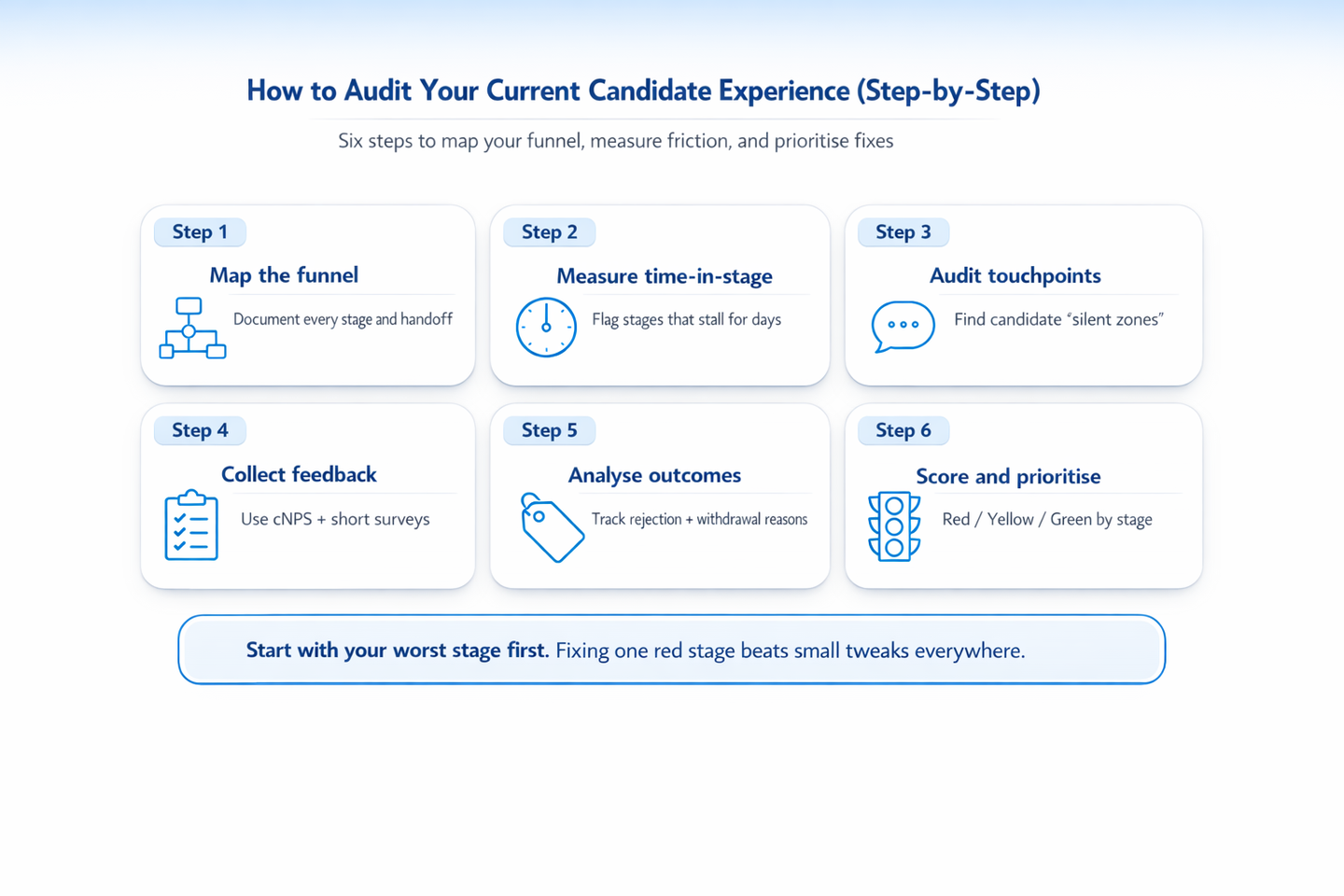
How to Audit Your Current Candidate Experience (Step-by-Step)
Before optimising, you need a baseline. A candidate experience audit maps your entire hiring funnel, measures satisfaction at each stage, and identifies the specific drop-off points your ATS should address first.
Follow these six steps:
Step 1: Map your current hiring funnel end-to-end. Document every stage from job posting through offer acceptance and first-day onboarding. Include every handoff, communication touchpoint, and decision point. Most teams discover steps they had forgotten or assumed someone else owned.
Step 2: Identify time-in-stage benchmarks. For each stage, record how long candidates typically spend there. Flag any stage where the median dwell time exceeds a few business days. Extended time-in-stage is the earliest indicator of process friction.
Step 3: Review communication touchpoints and gaps. List every automated and manual message a candidate receives. Look for "silent zones" where candidates hear nothing for multiple days. In 2024, 36% of candidates were still waiting one to two or more months for next steps after applying. Even a short acknowledgement can prevent that experience.
Step 4: Collect candidate feedback. Send brief satisfaction surveys at key moments: after application, after interview, and after offer or rejection. Candidate experience surveys have risen from 25% adoption to 40% in just one year, indicating that more organisations recognise the value of this data. Use a simple Candidate Net Promoter Score (cNPS) question plus one or two open-ended fields.
Step 5: Analyse rejection and withdrawal reason data. Pull your ATS reports on why candidates were rejected or withdrew. Look for patterns by role, stage, and source. If your ATS does not currently capture structured rejection reasons, configuring this should be an immediate priority. Wantedly Hire, for example, allows you to customise and standardise outcome reasons so that every data point is analysis-ready.
Step 6: Score each stage and prioritise fixes. Assign each funnel stage a simple red/yellow/green rating based on time-in-stage, satisfaction score, and drop-off rate. Focus your optimisation effort on the red stages first. (A red stage is one where friction is clearly hurting the process, for example through long delays, poor communication, or unusually high candidate withdrawal.) A single improvement to your worst-performing red stage will produce more measurable impact than incremental tweaks to stages that already work reasonably well.
Ready to see how analytics can accelerate your audit? Request a demo of Wantedly Hire to explore how our funnel reporting and custom fields make candidate experience audits faster and more actionable.
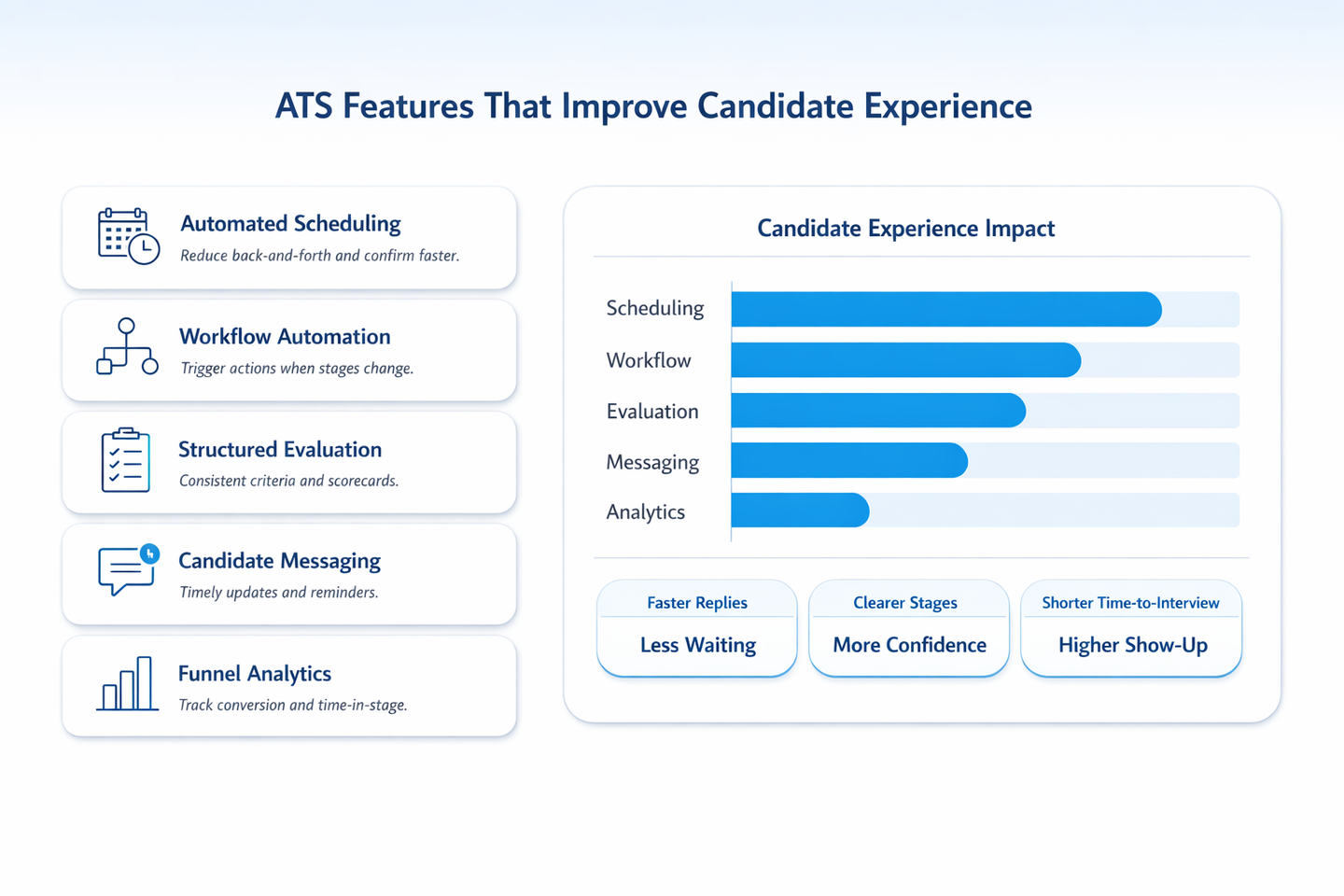
Which ATS Features Actually Improve Candidate Experience?
Not every ATS feature impacts candidate experience equally. The highest-impact capabilities are those that most directly improve hiring speed, candidate experience, selection quality, process consistency and source efficiency. In practice, that usually means automated interview scheduling, real-time status notifications, structured evaluation frameworks, customisable hiring workflows and source-level funnel analytics.
Here is what to look for in each:
- Automated interview scheduling. The feature should support multi-interviewer coordination with AND/OR logic, calendar sync, and candidate self-booking links. This single capability can eliminate the largest source of scheduling delay and reduce recruiter time spent on coordination. Wantedly Hire's automated scheduling generates availability links from multiple interviewers' calendars, so candidates select a time and the booking is confirmed instantly.
- Workflow automation and default actions. When a candidate enters a new stage, the ATS should be able to trigger a pre-set action: send a scheduling link, dispatch an email template, or create a task for the hiring manager. This prevents candidates from sitting in a stage with no communication.
- Structured interview kits. Customisable scorecards per role, a standardised set of criteria, and a pre-built question bank ensure that every interviewer evaluates on the same dimensions. In 2024, 72% of companies were using structured interviews, up significantly from prior years. The trend is clear: structure is becoming the standard.
- Candidate communication automation. Stage-triggered emails, overdue-task alerts for recruiters, and automated reminders for interviewers keep the process moving. The ATS should also support Slack integration or similar tools so the hiring team gets real-time notifications without living inside the ATS.
- Rejection-reason tracking. The ability to classify and report on why candidates are rejected or withdrawn is what turns raw data into actionable insight. Without it, you cannot diagnose the root cause of high drop-off at any given stage.
- Analytics dashboards. Custom reports that track funnel conversion rates, time-in-stage by role and source, and yield against hiring targets let you monitor candidate experience health continuously rather than in periodic audits. Wantedly Hire provides advanced reporting with custom fields, filters, and chart types that can be built directly in the system without exporting to spreadsheets.
The common thread across all of these features is visibility. An ATS that keeps candidates informed while giving the hiring team clear data on where the process breaks down is the foundation of sustainable candidate experience improvement.
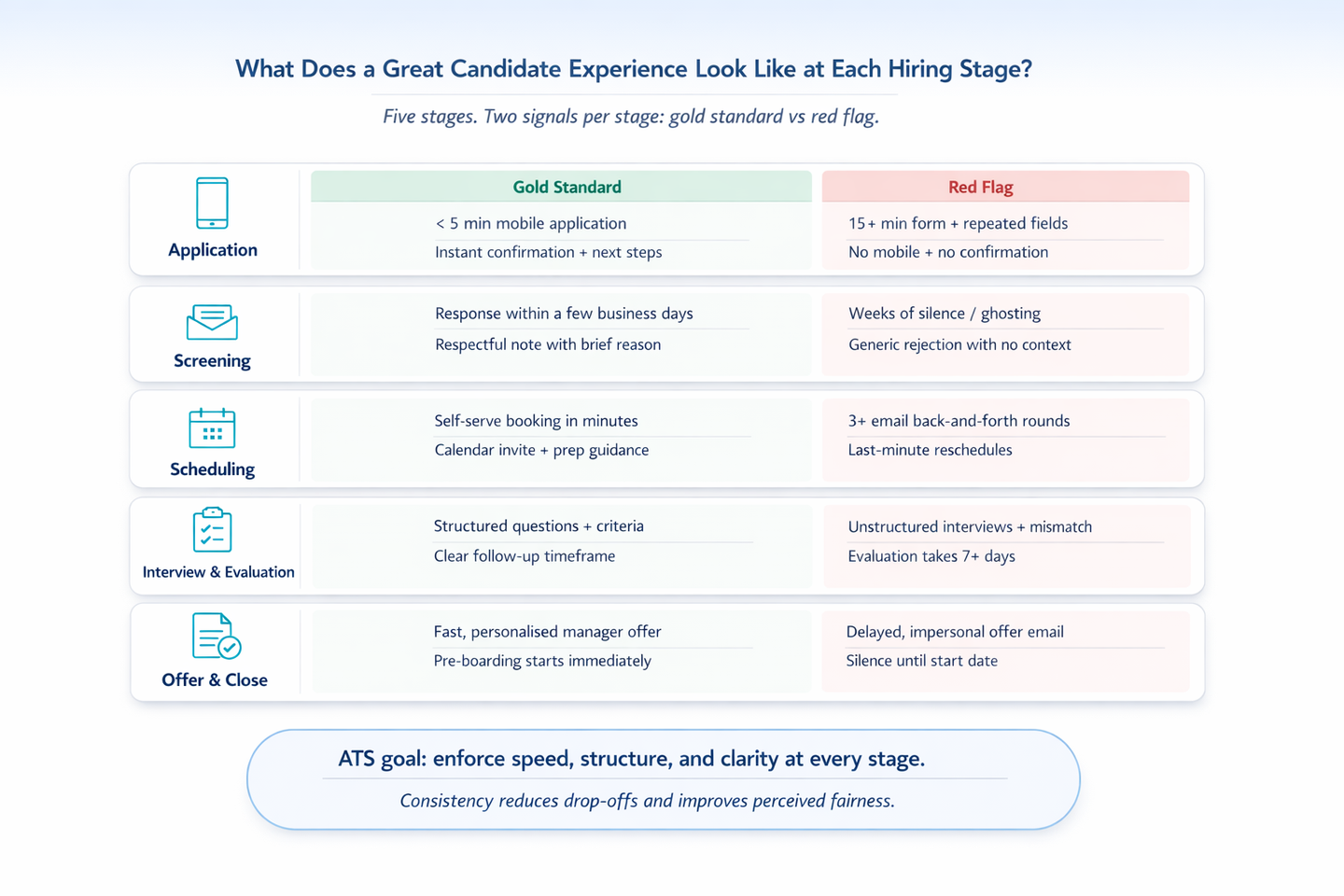
What Does a Great Candidate Experience Look Like at Each Hiring Stage?
A great candidate experience is consistent and measurable across five stages: application, screening, interview scheduling, evaluation and interview, and offer and close. Each stage has distinct candidate expectations, and your ATS should enforce standards at every one.
Application Stage
The gold standard is a mobile-friendly application that takes less than five minutes to complete, uses resume parsing to minimise manual entry, and sends an instant automated confirmation. Candidates should know their application was received and what happens next.
The red flag is a form that requires more than 15 minutes, asks for information already on the resume, offers no mobile option, and sends no confirmation. This is where the 60% application abandonment rate originates.
Screening Stage
The gold standard is a response within a few business days, whether the candidate advances or not. Rejected candidates receive a respectful notification with a brief, honest reason. Advancing candidates receive clear instructions on the next step.
The red flag is weeks of silence followed by either ghosting or a generic rejection with no context. In 2024, 40% of job seekers said they were ghosted after a second or third-round interview. Early-stage ghosting is even more common and equally damaging.
Scheduling Stage
The gold standard is a self-service booking experience where candidates choose from available time slots, receive instant confirmation, and get a calendar invite with interviewer details and preparation guidance. The whole process should take minutes, not days.
The red flag is three or more rounds of email coordination, last-minute reschedules, and no preparation materials. This is where Wantedly Hire's automated scheduling has the most direct impact, allowing candidates to book directly against multiple interviewers' real-time availability.
Interview and Evaluation Stage
The gold standard is a structured interview where candidates are told in advance what to expect, asked consistent and relevant questions, and evaluated on pre-defined criteria. After the interview, follow-up happens within a clear timeframe.
The red flag is an unstructured conversation where each interviewer asks different questions, no feedback timeline is shared, and evaluation takes more than a week to compile. Structured interviews have been identified as the strongest predictor of job performance in a 2022 meta-analysis by Sackett and colleagues, with a mean operational validity of 0.42, exceeding even cognitive ability tests. When candidates experience a structured process, they recognise it as fairer and more professional, which improves satisfaction regardless of outcome.
Offer and Close Stage
The gold standard is a fast, personalised offer communicated by the hiring manager directly, with clear terms and a defined acceptance timeline. Pre-boarding engagement, such as a welcome message, team introductions, or resource sharing, begins immediately after acceptance.
The red flag is a delayed, impersonal offer letter delivered by email with no personal touch, followed by silence until the start date. Research shows that a positive pre-boarding experience can increase a new hire's willingness to refer others and engage with the company brand by up to 137%, compared to 110% for all hired candidates without specific pre-boarding efforts.
7 Common Mistakes That Destroy Candidate Experience (And How to Avoid Them)
Most candidate experience failures are not caused by bad intent but by process gaps your ATS should prevent. Here are seven of the most common, along with their fixes.
Mistake 1: No confirmation email after application. Why it happens: The ATS either lacks an auto-responder or it was never configured. Candidates submit their application and receive nothing. The fix: Configure an automatic confirmation email for every application source. Include what the candidate can expect next and a realistic timeline.
Mistake 2: Interview scheduling takes more than five business days. Why it happens: Manual coordination across multiple interviewer calendars creates delays, and each round of back-and-forth adds days. The fix: Use automated scheduling with calendar integration and candidate self-booking. This single change can cut scheduling time significantly, and the reduction in delay directly lowers candidate drop-off rates.
Mistake 3: Rejected candidates never hear back. Why it happens: Recruiters prioritise advancing candidates over closing out rejected ones, and the ATS has no automated rejection workflow. The fix: Set up stage-exit triggers that send a respectful rejection email whenever a candidate is moved to a "not progressing" status. Personalise where possible, and consider including constructive feedback. Candidates who receive feedback are significantly more likely to consider the company in the future.
Mistake 4: Interviewers evaluate candidates on different criteria. Why it happens: No standardised scorecards exist, so each interviewer defaults to their own questions and gut instincts. The fix: Create structured evaluation templates in your ATS for each role. Wantedly Hire includes sample hiring criteria and interview questions for 12 job types, providing a starting point that teams can customise. Train interviewers on how to use scorecards consistently.
Mistake 5: The application form takes too long to complete. Why it happens: The form was designed by committee and accumulates fields over time without anyone auditing the experience from the candidate's perspective. The fix: Audit your application form quarterly. Remove any field that duplicates information available on the resume. Target a completion time under five minutes. Enable resume parsing so candidates do not need to re-enter their work history manually.
Mistake 6: No internal alerts for overdue candidate actions. Why it happens: Without automated reminders, candidates can sit in a stage for days or weeks simply because the responsible team member forgot or was busy with other priorities. The fix: Configure your ATS to send internal alerts when a candidate has been in any stage beyond a set threshold. Wantedly Hire's overdue-task alerts surface candidates who need attention, so nothing falls through the cracks.
Mistake 7: Never measuring candidate satisfaction. Why it happens: Teams assume they know how candidates feel, or they deprioritise feedback collection because it seems like extra work. The fix: Deploy a one-question cNPS survey at the rejection and offer stages. Track trends monthly. Even minimal measurement creates accountability and surfaces problems before they become patterns. In 2024, only 21% of candidates had ever been surveyed about their satisfaction with the hiring process. Simply asking puts you ahead of most organisations.
How to Use Structured Interviews to Improve Candidate Experience
Structured interviews, where every candidate is evaluated using the same criteria, questions, and scoring rubric, improve candidate experience by making the process feel fair, professional, and transparent while also producing better hiring outcomes.
The research backing is strong. A landmark 2022 meta-analysis found that structured interviews are the strongest predictor of job performance among all personnel selection methods, with a mean operational validity of 0.42, exceeding cognitive ability tests, work samples, and biographical data. Earlier research had placed structured interview validity at .51, compared to 0.38 for unstructured interviews. Regardless of which estimate you use, the direction is consistent: structure predicts performance far better than informal conversation.
From the candidate's perspective, structured interviews feel more respectful. Candidates recognise when they are being evaluated against clear criteria rather than subjected to random or biased questioning. This perception of fairness improves satisfaction scores even among candidates who are ultimately rejected.
Here is how to implement structured interviews through your ATS in three steps:
Step 1: Define criteria per role. Identify the three to five competencies or traits that predict success in the role. Create a scoring rubric with behavioural indicators for each level. If you are starting from scratch, Wantedly Hire includes sample evaluation criteria for 12 job types, covering roles from engineering to executive leadership, so you can start immediately and customise over time.
Step 2: Build question banks. For each competency, develop two to three behavioural or situational questions. Store these in your ATS as reusable templates that interviewers can access directly in the evaluation flow.
Step 3: Train interviewers and track adherence. Distribute the scorecard before each interview. After the interview, require evaluators to submit their scores through the ATS. Review completion rates and score distributions regularly. Consistency across interviewers is the metric that tells you whether structure is actually being followed in practice.
Want to see structured interviews in action? Wantedly Hire's built-in criteria templates and scorecard system let you launch structured interviews in hours, not weeks. Request a demo to explore how it works.
How Automation and AI Are Changing Candidate Experience in Asia
AI and automation are reshaping candidate experience across Asia by enabling faster scheduling, personalised communications, and predictive analytics, but the most effective approach balances automation speed with human touchpoints at key decision moments.
The adoption curve is steep. In 2025, 97% of companies surveyed planned to invest further in automation and efficiency tools for talent acquisition, with 32% focusing on personalisation and 25% specifically targeting candidate experience improvements. Across Asia-Pacific, candidates are also adopting AI: a 2025 Gartner survey found that 18% of candidates in the Asia-Pacific region admitted to using generative AI in real-time during interviews, compared to 13% globally.
This creates a dynamic where both sides of the hiring process are being augmented by technology, and the risk of impersonality is real. In the same Gartner survey, 68% of candidates said they prefer human interactions over AI or chatbot interactions during hiring, an increase from 58% two years prior.
The practical framework for Asian hiring teams is to automate logistics while keeping humans at the moments that matter:
Automate these:
- Interview scheduling and calendar coordination
- Application confirmation and stage-transition emails
- Reminder nudges for overdue interviewer evaluations
- Funnel reporting and progress-against-target dashboards
Keep human for these:
- First meaningful conversation with a candidate (casual chat, phone screen)
- Interview delivery and evaluation
- Offer discussion and negotiation
- Rejection of final-stage candidates (a personal note or call makes a lasting impression)
The takeaway is not to resist automation but to deploy it intentionally. Every automated message your ATS sends is one fewer gap where a candidate might feel forgotten. Every human interaction you protect is an opportunity to build trust that no chatbot can replicate.
Candidate Experience Optimisation Checklist
Use this 20-point checklist to evaluate and improve candidate experience across your entire hiring funnel. Score yourself by counting "yes" answers: 16 or above is strong, 11 to 15 needs improvement, and 10 or below is urgent.
Application (4 items):
[ ] Applications can be completed on mobile in under five minutes
[ ] Resume parsing auto-fills key fields to reduce manual entry
[ ] An automated confirmation email is sent within five minutes of submission
[ ] The confirmation email includes a realistic timeline for next steps
Screening (3 items):
[ ] Initial response (advance or reject) is sent within five business days
[ ] Rejection emails are personalised and include at least a brief reason
[ ] Advancing candidates receive clear instructions for the next step
Scheduling (4 items):
[ ] Candidates can self-book interview slots from available times
[ ] Multi-interviewer availability is coordinated automatically (no email chains)
[ ] Calendar invites include interviewer name, format, and preparation tips
[ ] Rescheduling is possible through a self-service link
Interview and Evaluation (5 items):
[ ] Every role has a defined scorecard with standardised criteria
[ ] Interviewers complete their evaluation in the ATS within 24 hours
[ ] Candidates are told at the start of each interview what competencies will be assessed
[ ] Post-interview follow-up is sent within two business days
[ ] Overdue evaluations trigger an automatic alert to the interviewer and recruiter
Offer and Close (4 items):
[ ] Offers are extended within three business days of the final interview
[ ] The hiring manager delivers the offer personally (phone or video, not just email)
[ ] Pre-boarding communication begins within 48 hours of acceptance
[ ] A brief candidate satisfaction survey is sent at the offer or rejection stage
Print this checklist, score your current process, and focus on the first red item. Small, specific improvements compound faster than large, vague initiatives.
How Wantedly Hire Helps You Deliver a Better Candidate Experience
Wantedly Hire is a modern ATS built to solve the exact candidate experience challenges this guide covers, with automated multi-interviewer scheduling, customisable structured interviews, real-time funnel analytics, and flexible workflow design purpose-built for hiring teams in Japan and Singapore.
Here is how our platform maps to each of the core candidate experience levers:
Scheduling automation. Wantedly Hire's automated scheduling uses AND/OR logic across multiple interviewers' calendars to generate availability links. Send the link to a candidate via chat or email, and the interview is booked. No back-and-forth. Available on all plans.
Workflow automation. Set default actions for each pipeline stage. When a candidate moves into a new step, Wantedly Hire can automatically send a scheduling link, dispatch a templated email, or flag the candidate for attention, all with a single click. This ensures no candidate sits in silence waiting for a next step.
Structured interview framework. Our platform includes sample hiring criteria and interview questions for 12 job types, from engineering to management to executive roles. You can start structured interviewing on day one and customise templates as you learn what works for your team. Scorecards are built into the evaluation flow, so interviewers submit standardised assessments directly inside the ATS.
Analytics and reporting. Wantedly Hire provides advanced, in-system reporting with dozens of field types, filters, and chart options. Track funnel conversion rates, time-in-stage, hiring target progress, and source performance without exporting data to spreadsheets. When hiring targets and deadlines are set, the system automatically calculates yield projections and surface alerts when targets are at risk.
Rejection and withdrawal reason tracking. Customise and standardise the reasons candidates are rejected or withdraw. This data feeds directly into your analytics, enabling you to diagnose problems by role, stage, and source.
Slack integration. Real-time notifications about new candidates and pending tasks are pushed to Slack, so your hiring team stays responsive without needing to live inside the ATS.
Trusted by companies including CyberAgent, freee, Lancers, and Supership, Wantedly Hire is designed for teams that take hiring seriously and want a system that grows with them.
Ready to see how it works? Request a free demo and explore whether Wantedly Hire is the right fit for your team's candidate experience goals.
FAQ: Candidate Experience Optimisation
What is candidate experience optimisation? Candidate experience optimisation is the ongoing practice of improving every interaction a job applicant has with your company, from the first job listing through onboarding, using ATS automation, structured evaluation, data analysis, and timely communication to reduce friction and increase offer acceptance. It is not a one-time project but a continuous improvement cycle.
How does an ATS improve candidate experience? An ATS improves candidate experience by automating repetitive tasks like interview scheduling and status updates, standardising evaluations with structured scorecards, and providing analytics to identify where candidates drop off. This lets your team fix specific bottlenecks rather than relying on guesswork.
What metrics should I track to measure candidate experience? The most important metrics are Candidate Net Promoter Score (cNPS), application completion rate, average time-in-stage, offer acceptance rate, and withdrawal rate with reason codes. Track these inside your ATS and review monthly to spot trends. Exact benchmarks vary by industry and region, so start by calibrating against your own historical data and supplement with published industry reports from sources like the Talent Board or SHRM.
How long should each stage of the hiring process take? While specific benchmarks vary by role and market, research consistently shows that longer processes correlate with higher candidate drop-off. A general guideline is that no individual stage should leave a candidate waiting without communication for more than a few business days. The average total time to hire reached 46.2 days in 2025, but top-performing teams are working to compress each stage through scheduling automation and faster decision-making workflows.
What is a structured interview, and why does it improve candidate experience? A structured interview uses a pre-defined set of questions and a standardised scoring rubric applied to all candidates for the same role. It improves candidate experience because applicants perceive the process as fairer and more professional. Research confirms that structured interviews are also the strongest predictor of job performance, with a 2022 meta-analysis placing their operational validity at 0.42, the highest among all selection methods studied.
Can automation hurt candidate experience? Yes, if applied without care. Automating scheduling, confirmations, and status updates improves speed and consistency. However, automating high-stakes touchpoints like interviews or rejection conversations without human oversight can feel impersonal. A 2025 Gartner survey found that 68% of candidates prefer human interactions over AI or chatbot interactions during hiring. The most effective approach automates logistics while preserving human connection at decision points and moments that require empathy.
Wantedly Hire is an application tracking system optimised for modern hiring practices. Experience seamless hiring with tailored workflows designed to align with your recruitment structure, automated interview scheduling, and actionable insights to optimise hiring performance!
Sign up for a demo and enjoy a limited-time discount on your subscription.
/assets/images/7053115/original/43c7433b-4920-4cf1-b0b0-c44aec7bd947?1624242511)


)/assets/images/7053115/original/43c7433b-4920-4cf1-b0b0-c44aec7bd947?1624242511)

/assets/images/21128915/original/43c7433b-4920-4cf1-b0b0-c44aec7bd947?1747371924)