
Structured interview scorecards are a practical way for SMEs to make hiring decisions that are consistent, fair and linked to real job performance. In this context, “scorecards” means structured interview forms that define what you are assessing, which questions uncover it, and how interviewers should record and rate what they observe.
Across multiple studies and evidence reviews, structured interviews consistently outperform informal, unstructured conversations in predicting job performance and reducing bias. Professional bodies such as CIPD also recommend structured interviews to support fair, inclusive selection decisions. For an SME, that matters because every hire has a strong impact on culture, delivery and customer outcomes.
In this article, I focus on how you can design and implement structured interview scorecards within Wantedly Hire and how to keep them useful over time.
Why Do Structured Interview Scorecards Matter For SMEs That Want Consistent Hiring Decisions?
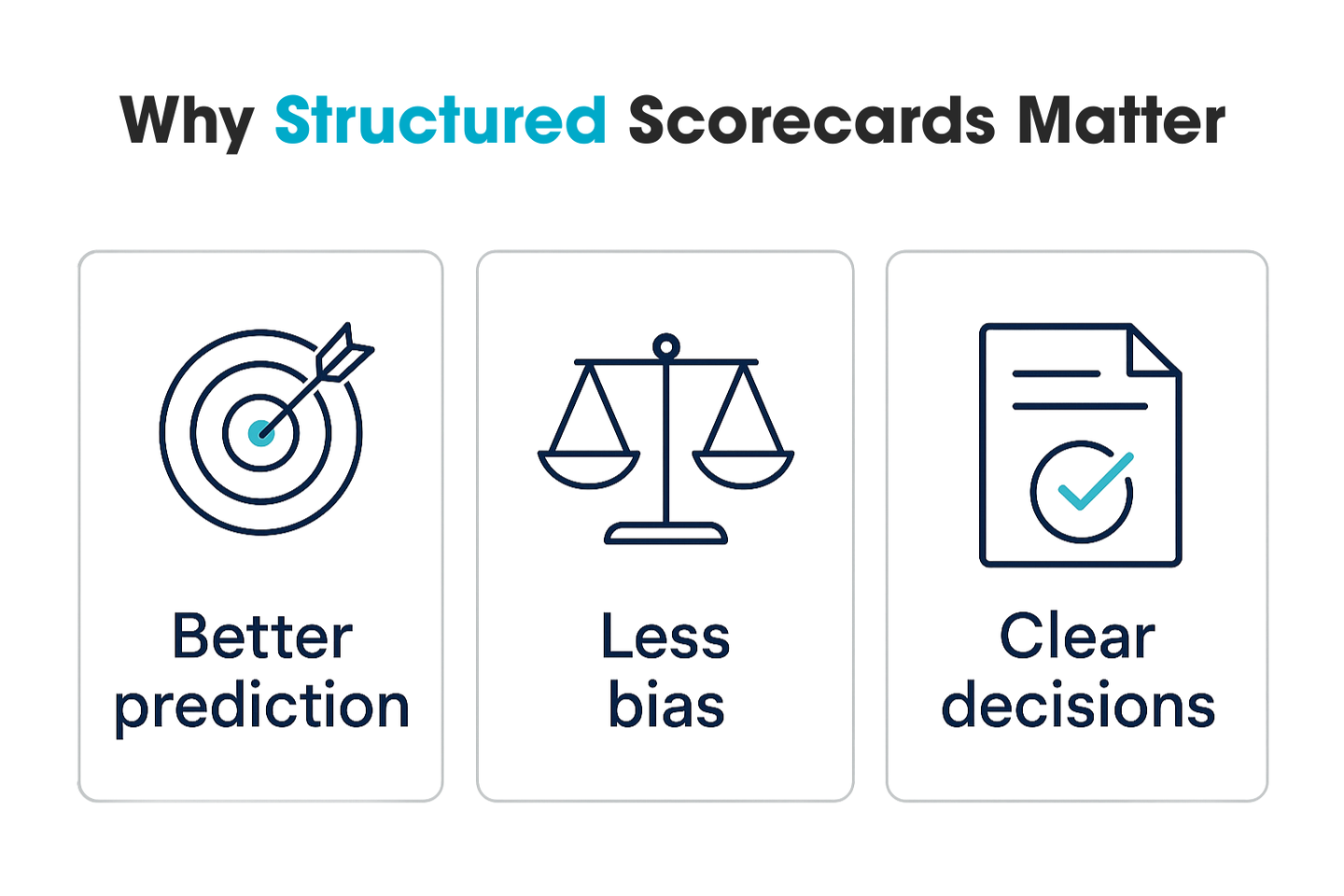
There are three main reasons structured interview scorecards are important for SMEs.
First, they improve prediction. Meta-analyses across decades of research show that structured interviews have significantly higher predictive validity for job performance than unstructured interviews, and rank among the most effective selection methods available. (ResearchGate) When you define criteria and questions in advance, you reduce randomness, which is essential when each hire matters.
Second, they reduce avoidable bias. CIPD guidance on inclusive recruitment notes that structured interviews help minimise bias and create a more level playing field, because interviewers compare candidates against the same criteria rather than vague impressions. For SMEs that may not have dedicated HR specialists in every interview, a clear scorecard is a practical safeguard.
Third, they support faster and more transparent decisions. When interviewers use a shared structure, it becomes easier to compare candidates, explain decisions internally and document why someone was selected or not. That supports accountability and makes later performance discussions more grounded.
In Wantedly’s #HireSuccess series, the Mastering Structured Interviews article builds on the same logic. It highlights three pillars you need to structure: the target (ideal candidate), the questions and the evaluation. Those pillars translate directly into how you set up your scorecards in Wantedly Hire.
What Should A Practical Structured Interview Scorecard Look Like For SMEs Hiring?
A usable scorecard does not need to be complex. It should help interviewers move from business needs to clear hiring decisions.
At a minimum, a structured interview scorecard for SME roles should include:
- A short description of the role and what success looks like in 12–24 months
- A prioritised list of core competencies or criteria
- Behavioural or situational questions linked to each criterion
- A simple, defined rating scale
- Space to separate factual evidence from the interviewer’s judgment
Together, these elements give interviewers a clear structure they can follow in Wantedly Hire, from defining what matters in the role to asking focused questions and recording what they observe in a consistent way.
How To Define Your Hiring Target?
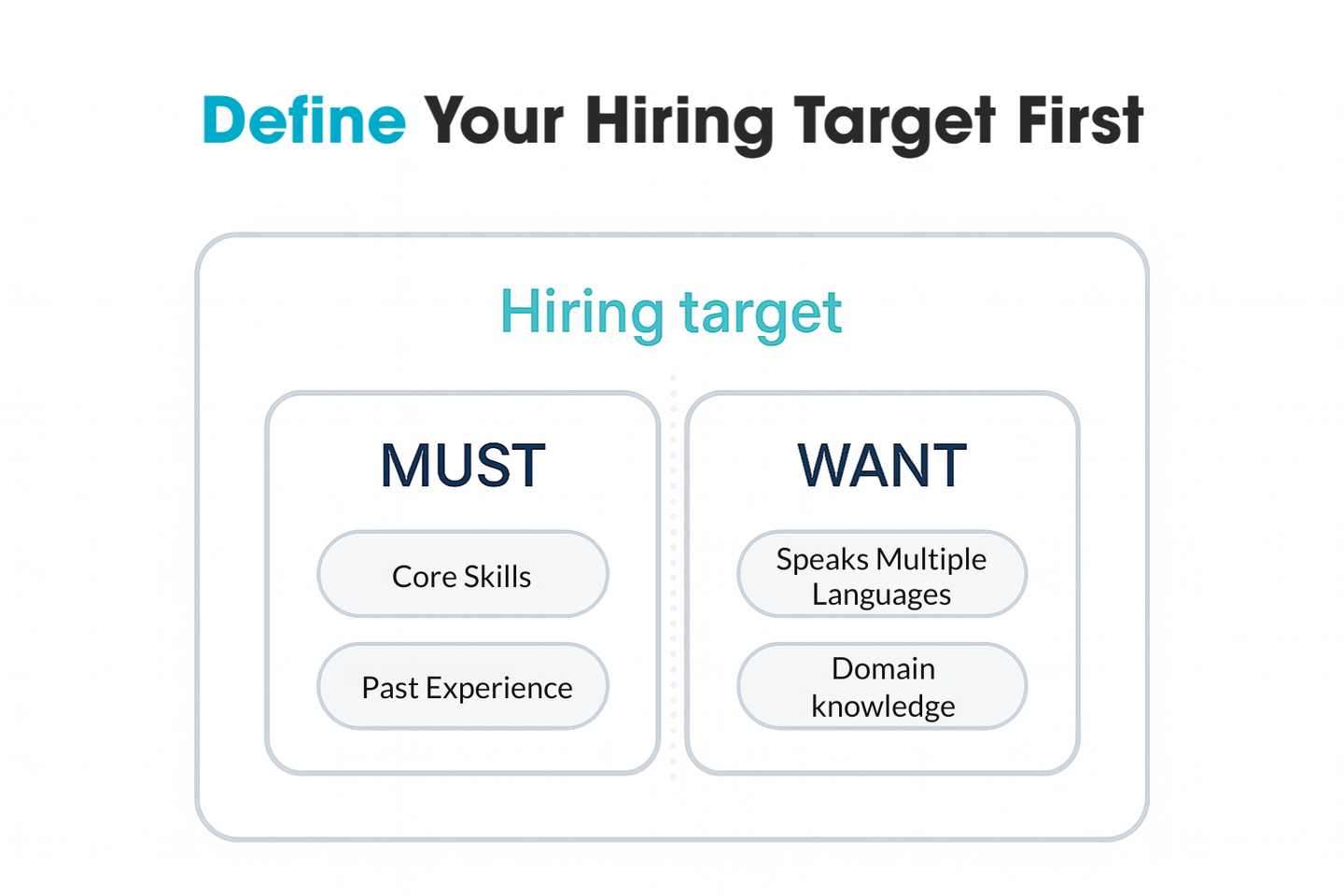
If you try to write questions and ratings before you agree on the hiring target, scorecards tend to feel vague and inconsistent. I suggest starting with three steps.
First, separate MUST and WANT criteria. Decide what the person must already be able to do on day one and what can be developed. Treat “MUST” as non-negotiable. If everything is a must-have, you narrow the pool unnecessarily.
Second, define what each competency really means. Terms such as “communication skills” or “ownership” are too broad. Translate each into observable behaviours. For example, “communication skills” might mean “structures updates clearly for non-experts” or “summarises trade-offs calmly under time pressure”.
Third, align stakeholders on these definitions. Before you open a role, hold a short calibration discussion with hiring managers and regular interviewers. The goal is a shared understanding of what “meets expectations” looks like for each criterion.
Once you have that, you can convert the agreed criteria into structured fields in Wantedly Hire, using its ability to register and customise hiring criteria at the job level.
How To Design Good Interview Questions?
A structured interview scorecard depends on well-designed questions. The most effective approach is to use behaviourally anchored questions and the STAR framework (Situation, Task, Action, Result), followed by deeper probing into context, reasoning and challenges.
Tie at least one behavioural question to each key criterion. Use STAR as your base, then follow up with questions about what options the candidate considered, why they chose a particular approach and what they would do differently next time. Avoid brainteaser-style questions that do not relate to the actual work.
Wantedly Hire supports this by allowing you to create and save interview question templates. You can reuse core questions across roles while still tailoring them for specific seniority levels or job contexts.
How should I structure evaluation scales for fairness?
Even strong questions will not give you consistent results if interviewers use the rating scale differently. Research on structured interviewing recommends clearly defined scales and deliberate separation of facts from opinions in evaluation notes. (Wantedly)
Use a simple 1 - 4 or 1 - 5 scale for each criterion. Define what each point means in plain language, such as “3 = consistently meets expectations in comparable roles”. Ask interviewers to record factual evidence first, then their rating and a short interpretation.
Wantedly Hire lets you customise the evaluation notes and criteria fields so that interviewers have a consistent structure to fill in. This lets you reflect the “facts first, judgment second” approach directly inside the ATS, rather than relying on unstructured documents.
How To Design A Structured Interview Scorecard That SMEs Actually Use with Wantedly Hire?
The phrase Structured Interview Scorecards That SMEs Actually Use means that scorecards should be part of your daily hiring system, not separate forms on a shared drive.
Since Wantedly Hire is a modern applicant tracking system with customisable templates, hiring processes, reporting and automated interview scheduling, using this ATS gives you a practical foundation to embed structured scorecards.
It helps to think in terms of three layers: the hiring workflow (stages, actions and ownership), the scorecard structure (criteria, questions and scales) and the collaboration environment (who can see and contribute what).
How can I configure structured scorecards within each stage of my hiring workflow?
In Wantedly Hire, you can design a personalised hiring workflow with customisable stages and automated workflows. Within a single stage, you can configure multiple actions, such as different interview types and assignments, and specify whether each action requires scheduling and evaluation.
A practical approach is:
- Map which stages should use structured scorecards. For many SMEs, this includes at least the first competency interview and the final decision interview.
- Attach your criteria and question templates at the relevant stages. Use Wantedly Hire’s ability to customise hiring criteria, interview questions and evaluation notes so that the right structure appears when interviewers open the evaluation form.
- Use default workflows to trigger reminders. Configure automated reminders so that when candidates move into an interview stage, scheduling links and follow-up messages are sent with minimal manual effort.
This keeps structured scorecards inside the same workflow that controls how candidates progress, rather than treating them as an extra step.
How To Use Interview Templates In Wantedly Hire?
For many SMEs, the main barrier to structured interviews is time. Wantedly Hire reduces that setup work by providing sample hiring criteria and interview questions for a range of job types, so teams can start interviewing without building everything from scratch.
You can begin with the sample templates closest to your role, adjust the criteria labels and definitions to match your MUST and WANT list, and refine behavioural questions so they reflect your actual work and culture.
Over time, you can build your own library of templates in Wantedly Hire for roles you hire for frequently. Because these templates live inside the ATS, you can apply them quickly to new openings, which makes structured interviewing easier to adopt and maintain.
If you want to give hiring managers a clear explanation of the method behind the templates, you can also introduce resources like Wantedly’s #HireSuccess: Mastering Structured Interviews article as a concise reference on structured interviewing and how it supports more consistent hiring.
How to align my team around a consistent scoring scale in Wantedly Hire?
A frequent challenge is that different interviewers use the same scale differently. Because Wantedly Hire allows you to customise interview evaluation notes, hiring criteria and questions you can use the tool itself to encourage alignment.
One practical step is to include scale definitions in the form. Add a brief description for each rating level in the evaluation template, so interviewers see the definition when they score.
Another is to ask interviewers to separate facts and opinions in notes. Where possible, use one area for observed or reported facts, such as “Candidate led a cross-functional project with four teams”, and a second area for interpretation, such as “Demonstrates sustained ownership under pressure”. This mirrors the guidance in #HireSuccess on separating facts from evaluations.
You can also hold periodic calibration sessions. Use a small set of anonymised evaluation examples from Wantedly Hire’s records to discuss why different interviewers scored the same behaviour differently. Because evaluations are recorded in a common format, these discussions stay concrete and focused.
Over a few hiring cycles, this calibration improves consistency without adding heavy process overhead.
How To Use Hiring Data To Improve Scorecards In Wantedly Hire?
Once scorecards are part of your workflow, the next step is to use your own data to refine them. Wantedly Hire includes analytics that let you capture reasons for rejections and withdrawals, and track conversion rates and time spent at each stage. (hire.wantedly.com)
Start by standardising a short list of rejection and withdrawal reasons, such as “salary misalignment”, “skills gap on core competency” or “candidate withdrew due to another offer”. Review patterns by role and stage in Wantedly Hire’s reports to see where issues cluster. If rejections for the same competency keep appearing late in the process, strengthen earlier questions. If withdrawals spike at a specific stage, check whether expectations were clear enough earlier in the funnel.
Then look at conversion rates between stages. Set reasonable hiring targets and timeframes, and compare pass rates across roles with similar scorecards. If one scorecard has much lower pass rates at the same stage, it may indicate that the bar is set too high or that questions are too abstract for candidates to answer effectively.
Handled this way, structured interviews are directly connected to your performance data in Wantedly Hire, rather than sitting apart from how you monitor and improve your hiring.
How To Implement Structured Interview Scorecards Step By Step In An SME Team?
Even with a clear design, adoption will not happen if the rollout feels heavy to busy managers. A staged approach that uses Wantedly Hire’s quick setup and onboarding support can keep things manageable.
A practical five-step path is:
- Choose one role and one workflow. Start with a role you hire for regularly, such as a sales executive or associate engineer. Map its existing stages inside Wantedly Hire and confirm who owns each step.
- Configure a basic structured scorecard. Use Wantedly Hire’s templates and sample criteria to set up a simple scorecard for one interview stage, with three to five core competencies, defined scales and two to three behavioural questions per competency.
- Train a small group of interviewers. Walk them through the structure, show how it appears in Wantedly Hire and explain how their notes will be used. Encourage them to read the #HireSuccess structured interviewing article so they see the broader rationale.
- Use automation to minimise manual work. Take advantage of automated scheduling, reminders and workflows, so interviewers focus on structured questioning rather than logistics. Wantedly Hire embeds scheduling into the ATS, integrates with Google Workspace and Outlook calendars, and supports Slack notifications so teams can receive updates in channels they already use. (hire.wantedly.com)
- Review outcomes after one or two hiring cycles. Look at the consistency of evaluations, stage-by-stage conversion and withdrawal reasons using Wantedly Hire’s analytics features. Adjust criteria, questions and scales based on what you learn.
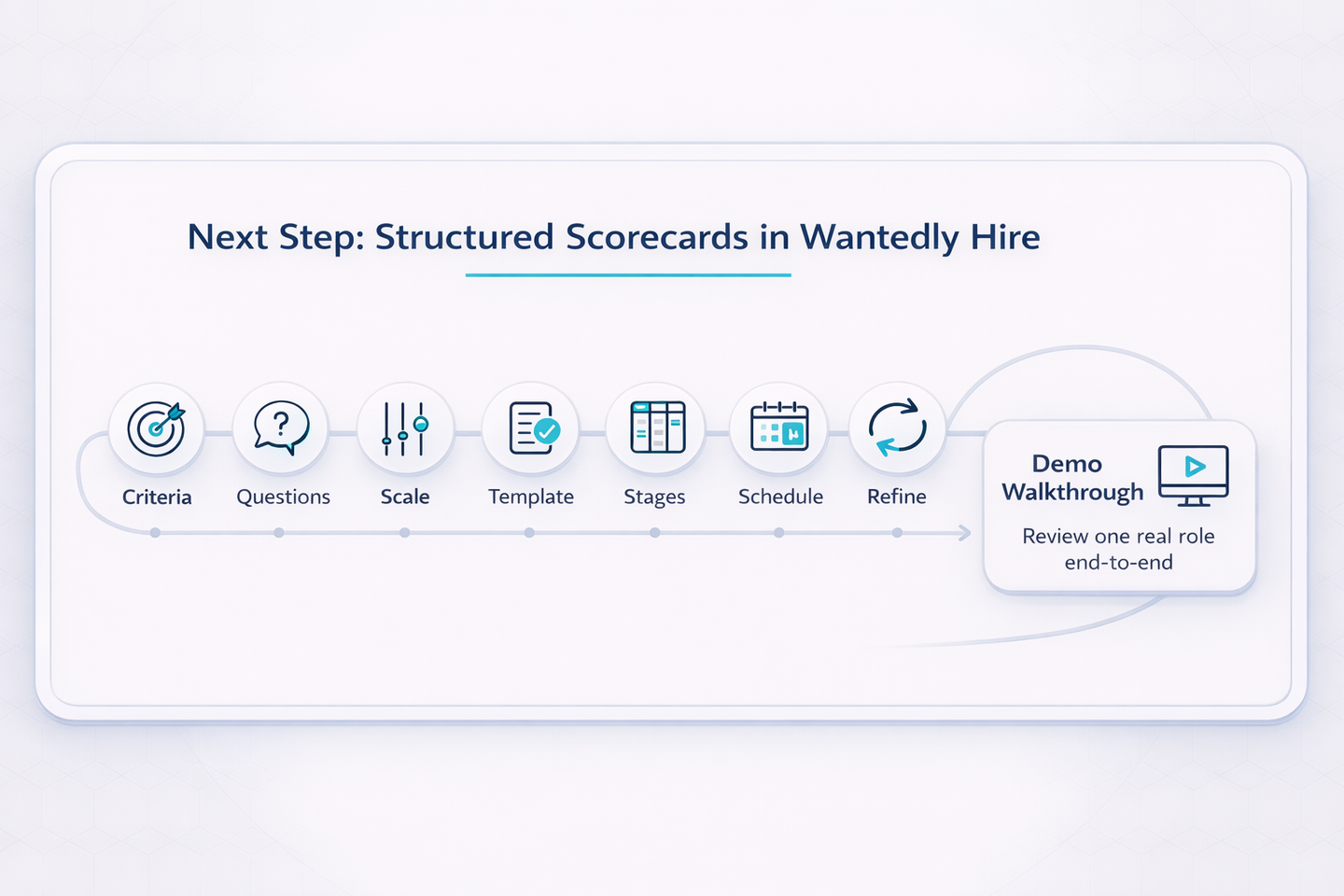
If you want to see how this works in practice, the next step is to request a Wantedly Hire demo. Share one role you hire for regularly and ask the team to walk through your current stages, criteria and scorecards on screen, so you can see how structured interviewing would look inside your own workflow.
What Are Some Common Pitfalls When Using Structured Interview Scorecards?
Scorecards and tools only work when they are used thoughtfully. The main pitfalls relate to behaviour and process, not the software itself.
How can I prevent scorecards from becoming a checkbox exercise?
A scorecard can lose value if interviewers rush through questions or rely on overall impressions. To keep it meaningful, emphasise that the goal is better evidence, not more paperwork. Encourage interviewers to write short but specific factual notes before assigning ratings.
You can periodically review a sample of completed scorecards in Wantedly Hire to see whether comments genuinely reflect the criteria. Because Wantedly Hire centralises evaluations, you can see whether fields are being used as intended and provide simple reminders or refreshers when needed.
How can I keep interviewers engaged and trained without overloading them?
Most SME interviewers have demanding day jobs. Small, focused actions usually work best. You might provide a one-page guide summarising your criteria, question types and scale definitions, run short calibration sessions tied to real roles using anonymised examples from Wantedly Hire, and use Slack notifications and reminders to keep interviewers aware of upcoming interviews and pending evaluations, using the integration that Wantedly Hire offers.
This keeps structured interviewing visible without becoming a large separate training programme.
What Is The Next Step With Structured Interview Scorecards In Wantedly Hire?
If you want Structured Interview Scorecards That SMEs Actually Use, bring them into the centre of your hiring workflow in Wantedly Hire. Define clear criteria, design behavioural questions and set simple rating scales, then apply them to one or two roles you hire for regularly. Use Wantedly Hire’s templates, scheduling and analytics so interviewers can follow the same structure every time and you can refine scorecards using real data on conversions, rejections and withdrawals.
If you want to see how this would work for your team, request a demo through the Wantedly Hire page and walk through one of your current roles with the team. That session will show you how structured interview scorecards sit inside your actual pipeline and whether this is the right approach for your small-medium enterprise.
Wantedly Hire is an application tracking system optimised for modern hiring practices. Experience seamless hiring with tailored workflows designed to align with your recruitment structure, automated interview scheduling, and actionable insights to optimise hiring performance!
Sign up for a demo and enjoy a limited-time discount on your subscription.
/assets/images/7053115/original/43c7433b-4920-4cf1-b0b0-c44aec7bd947?1624242511)


)/assets/images/7053115/original/43c7433b-4920-4cf1-b0b0-c44aec7bd947?1624242511)


/assets/images/21128915/original/43c7433b-4920-4cf1-b0b0-c44aec7bd947?1747371924)