Why Candidates Withdraw and How to Fix It: Track Withdrawal Reasons in Your ATS

Why Candidates Withdraw and How to Fix It
Candidate drop-offs are one of the quietest but most expensive problems in SME hiring. You see fewer candidates at each stage, roles take longer to fill, and everyone feels that something is not working. Yet it is often unclear why people disappear, where they lost interest, or what you could have done differently.
When candidate withdrawals are properly defined and logged within a modern ATS such as Wantedly Hire, hiring teams gain visibility into the real drivers behind drop-offs across the recruitment funnel, enabling decisions based on evidence rather than assumptions.
In this article, we will look at how to track withdrawal reasons inside Wantedly Hire, how to reduce drop-offs in a practical 30-day window, and how to build a simple, auditable model that shows when your ATS investment has paid for itself.
How Do Candidate Drop-Offs Affect SMEs Hiring Performance?
For larger companies, a few lost candidates may not change much. For an SME with a lean hiring team, each withdrawal can delay decisions and add hidden costs.
How do untracked drop-offs slow time-to-hire and raise cost-per-hire?
When candidates drop out, and nobody records why, the team usually goes back to the start. Sourcing has to restart, screening work repeats, and managers sit through additional rounds of interviews. Roles remain open for longer, which affects delivery and morale.
All of that extra effort and delay pushes up cost-per-hire and time-to-hire. Because it is spread across many small actions, it rarely appears clearly in internal reports. Without structured withdrawal data, it is difficult to prove how much of this cost could have been avoided.
Why do lean SME teams feel the impact of drop-offs more quickly?
Most SMEs do not have a dedicated recruitment department. The same person may handle payroll, HR policies and hiring on top of other responsibilities. When a few strong candidates withdraw late in the process, it can throw the schedule off for weeks. Interviews are moved, internal meetings are rescheduled, and managers wait longer for support in their teams.
The smaller the organisation, the less buffer there is. A pattern of withdrawals that might be manageable in a large corporation can leave an SME constantly firefighting.
How does Wantedly Hire give you early visibility into these patterns?
Wantedly Hire provides analytics dashboards that show how many candidates apply, how they move through each stage and where they drop off. The system can also send alerts when it predicts that hiring goals may not be met, so teams can act before a role becomes urgent.
Instead of relying on scattered spreadsheets or manager anecdotes, you see a clear funnel. You can compare roles, time periods and hiring managers, and you can see withdrawals as part of that picture. This gives you an objective starting point for improvement and for any internal discussion about investing in better tools.
What Are “Withdrawal Reasons”, And How Does Wantedly Hire Capture Them?
Withdrawal reasons are the explanations attached to a candidate who leaves the process. On their own, they are small notes. Together, they show you which problems repeat and where to focus.
Which withdrawal reasons matter most for SME hiring teams?
Most SMEs will see similar themes. Candidates may accept another offer, feel that compensation is not in the right range, feel that the process is too slow, decide that the role is not what they expected or simply change their minds about moving jobs.
Some of these reasons are outside your control. Others are very clearly linked to process design, communication and positioning. The value of tracking withdrawal reasons is that you can separate the two and focus efforts where you can actually make a difference.
How can recruiters record withdrawal reasons directly in Wantedly Hire?
Wantedly Hire includes data analysis capabilities that allow teams to register reasons for rejections and candidate withdrawals. This makes it possible to run quantitative analysis and improve the hiring process over time.
In practice, this means that when a recruiter moves a candidate into a rejection or withdrawal state, they can record a standardised reason at the same time. That reason sits alongside the candidate’s history, the job they applied for and the stage at which they left. Over time, the analytics aggregate this information so that patterns become visible across multiple roles and periods.
Why using Wantedly Hire is more reliable than using manual methods like spreadsheets or email threads?
When teams try to track withdrawals outside the ATS, data quality suffers. People forget to update a shared file after a busy day. Different recruiters write the same reason in different words. Files get copied, renamed and lost. Even if someone pulls a report, it is difficult to link what they see back to specific stages or decisions.
Capturing reasons inside Wantedly Hire keeps everything close to the moment of action. Each reason is linked directly to a candidate and a stage in the funnel. You do not have to reconcile separate tools. As long as the hiring team follows the same simple habit, the dataset stays usable.
If you are curious how this looks in your context, a soft next step is to request a demo of Wantedly Hire and ask to see how withdrawal reasons appear in the analytics dashboard for a typical role.
What are the limits of using surveys and informal feedback for understanding the reasons for withdrawals?
Surveys sent after a candidate leaves the process can be helpful, but response rates tend to be low. Candidates who have already accepted another offer may not have time to respond. Those who do reply may give broad reasons that are difficult to classify, such as “the process felt long”.
Informal feedback gathered by recruiters in calls or messages can add colour, but it lives in individual inboxes and memories. It is rarely captured in a way that can be analysed at scale. Without a consistent structure, it is hard to tell whether a comment reflects a one-off situation or a recurring pattern.
How to select a small set of reasons that still gives useful insight?
Start by identifying the handful of reasons that you see most often. Group them into process-related, offer and terms, role and fit, and the candidate’s own situation. Within each group, choose labels that are specific enough to be informative, yet simple enough that recruiters can select them quickly.
When you configure your approach inside Wantedly Hire, you want recruiters to be able to record reasons as part of their normal workflow, not as a separate task. A small, well-designed list makes that possible and keeps the data usable.
How To Build An ATS Comparison Model That Shows Wantedly Hire’s ROI?
Moving to an ATS is often a strategic decision. Leaders want to know not only that the tool is better, but also when it will pay for itself. An auditable comparison model creates a common language between HR, hiring managers and finance.
Which cost items should SMEs include when comparing ATS options?
A useful model looks at three sets of numbers: direct costs, indirect costs and outcomes.
Direct costs cover subscription fees, any add-on modules and spending on agencies or job boards. Indirect costs include recruiter and manager time spent on manual coordination, such as scheduling, follow-up and chasing feedback. Outcome metrics capture how many qualified candidates reach each stage, the time taken to fill roles and the rate of withdrawals.
Wantedly Hire’s dashboards already track applications, conversions and drop-offs at each stage, as well as progress against hiring goals and potential shortfalls. These metrics provide concrete inputs for the outcome side of the model.
How can you use Wantedly Hire’s funnel and withdrawal data in your ROI calculations?
Once your team is consistently recording withdrawal reasons in Wantedly Hire, you can quantify how changes in the process affect those numbers. For example, if you streamline interview scheduling and automate reminders, you may see fewer withdrawals between screening and the first interview.
You can estimate how many repeated interviews you avoided, how much manager time you saved and how much faster roles closed compared with the baseline. That time saving can be translated into an internal cost figure and recorded as a benefit of using the system in a structured way.
How can you compare three scenarios: no ATS, a generic ATS and Wantedly Hire?
A simple worksheet can keep this comparison clear:
- Scenario one is your current state without an ATS. You record manual effort, current time-to-hire and estimated impact of drop-offs.
- Scenario two is a generic ATS with basic pipeline views and limited analytics. You estimate improvements based on what similar tools usually provide.
- Scenario three is Wantedly Hire, where you use its specific features such as analytics dashboards, withdrawal reason analysis and alerts on hiring goals to estimate improvements.
For each scenario, you list annual cost, expected hours saved and expected changes in key metrics such as drop-off rate and time-to-hire. As you collect real data in Wantedly Hire, you can replace estimates with actuals.
How should you document assumptions so your ATS decision is auditable?
To make the model auditable, keep a short record of the roles included, the time period, the internal hourly rates used and any assumptions about process changes. Save exports or screenshots from Wantedly Hire that show the underlying funnel and withdrawal numbers.
This way, finance and leadership can revisit the decision rationally if hiring volumes or budgets change.
How can the Wantedly Hire subscription model lower cost-per-hire over time?
Wantedly Hire offers subscription services with unlimited job postings and hiring, without success fees or hidden charges. It is designed to lower overall recruitment costs and reduce cost-per-hire by avoiding per-hire fees that scale with volume.
For SMEs, this matters. As hiring needs increase, costs do not spike in the same way they might with agency-based models. The savings from reduced drop-offs, faster processes and less manual effort sit on top of a predictable subscription cost.
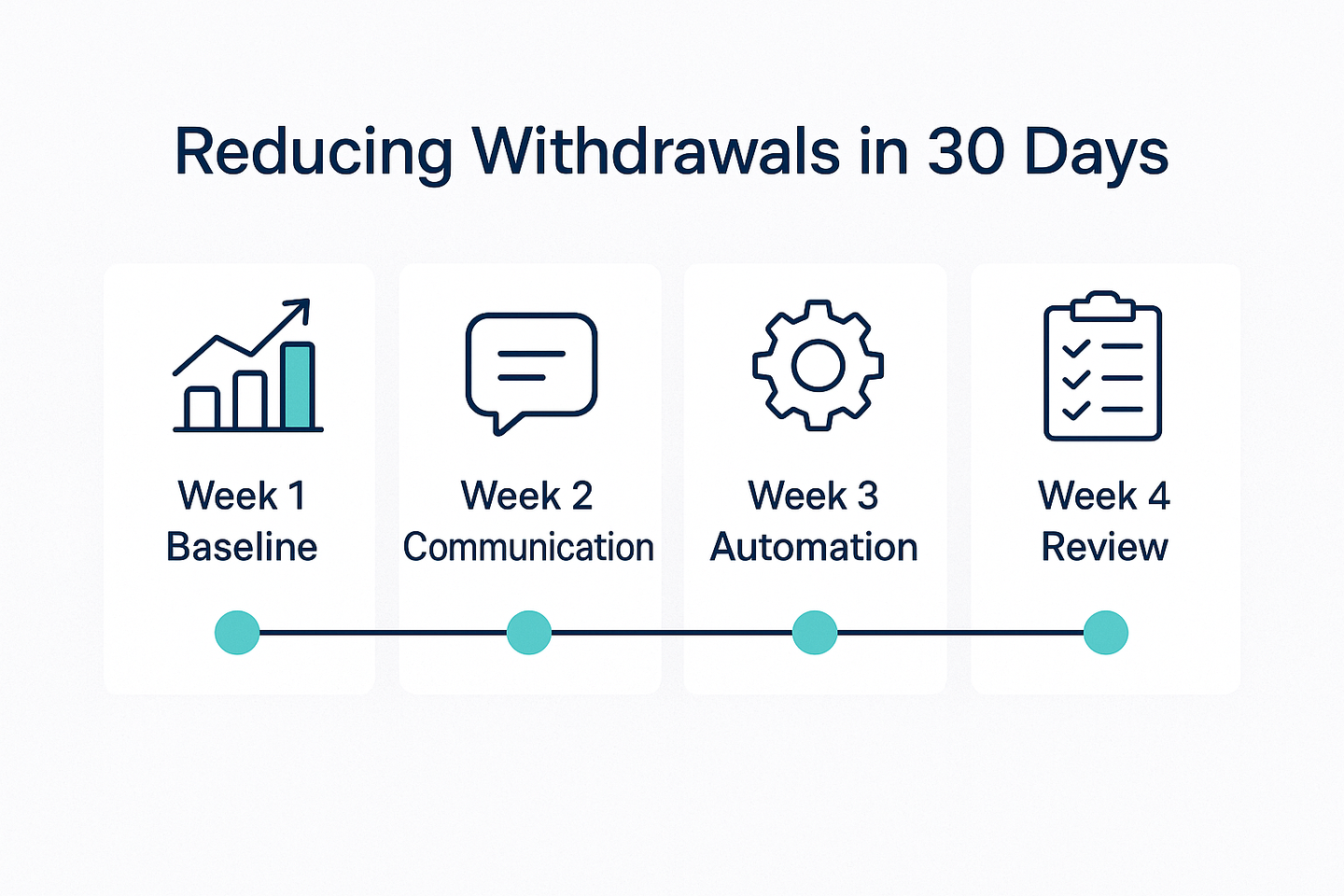
How Can Wantedly Hire Help You Reduce Withdrawals Within 30 Days?
SMEs often prefer to test improvements in a focused, short window. A 30 day plan is long enough to see changes, but short enough to keep attention.
How do you baseline your current funnel using Wantedly Hire dashboards?
In the first week, use Wantedly Hire to map your current funnel. Identify your main stages from application to offer, and pull basic metrics such as the number of candidates entering each stage, conversion rates and drop-offs. If you already record withdrawal reasons, note which ones appear most often and at which points.
This gives you a clear baseline. You will compare later results against this to see whether changes have made a difference.
How can you address key drop-off points with clearer communication and automation in Wantedly Hire?
Once you know where drop-offs cluster, choose one or two interventions. For example, if withdrawals spike between screening and first interview, you may decide to use scheduling automation and template messages in Wantedly Hire to confirm interview times more quickly.
If candidates often leave after the first interview due to uncertainty about role scope, you might refine your job descriptions and standardise talking points for hiring managers. Many of these changes rely on features that Wantedly Hire already offers, such as workflows, templates and centralised communication.
If you want to see which options are realistic for your team, explore a demo of Wantedly Hire with a focus on automation, templates and communication, rather than a general product walk-through.
How do you run one focused improvement experiment each month inside Wantedly Hire?
Treat the 30 days as a structured experiment. Set a clear goal, such as reducing withdrawals at one specific stage by a defined percentage. Decide which change you will make to support that goal, and apply it consistently to all relevant roles during the period.
Throughout the month, monitor the relevant metrics in Wantedly Hire. At the end of the period, compare withdrawal counts, conversion rates and time between stages to your baseline.
Even if the improvement is modest, you will have proven a method that you can repeat for other stages and roles.
How do you track changes in conversion and withdrawal trends over time?
After the first experiment, continue to track your key metrics month by month. Wantedly Hire centralises funnel and performance data, which makes these comparisons straightforward.
You can then decide whether to reinforce the change, refine it or test a new one. Over time, repeated small improvements compound into better hiring performance and a more stable pipeline.
Next steps
If you are seeing regular candidate drop-offs and are not sure why, tracking withdrawal reasons and acting on them is a practical way to improve your hiring funnel. Wantedly Hire already provides the core capabilities you need: analytics dashboards that show applications, conversions and drop-offs, tools to record and analyse withdrawal reasons, and a subscription model designed to reduce cost-per-hire over time.
If you want to make drop-offs visible, reduce withdrawals and build a stronger, evidence-based case for your hiring tools, request a Wantedly Hire demo and use the next month to see what changes you can create in your own data.
Wantedly Hire is an application tracking system optimised for modern hiring practices. Experience seamless hiring with tailored workflows designed to align with your recruitment structure, automated interview scheduling, and actionable insights to optimise hiring performance!
Sign up for a demo and enjoy a limited-time discount on your subscription.
/assets/images/7053115/original/43c7433b-4920-4cf1-b0b0-c44aec7bd947?1624242511)


)/assets/images/7053115/original/43c7433b-4920-4cf1-b0b0-c44aec7bd947?1624242511)

/assets/images/21128915/original/43c7433b-4920-4cf1-b0b0-c44aec7bd947?1747371924)