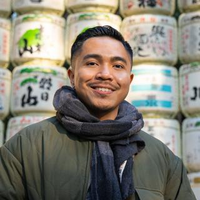
Prior to moving to Japan for work in 2018, Jake Dolosa worked as an in-house graphic designer with several large international companies in the Phillippines. In 2022, he joined Shiitake Creative as Art Director.
With previous experience predominantly in larger companies, the move to a small business was not an easy decision at first. But as he would soon discover, trusting himself in taking that decision was what he needed at the time. A small team not bound by hierarchy and a casual broad-minded work environment ensured more freedom for creativity and self-expression. It also often meant wearing different hats at work and testing his skills across various creative fields, which he believes is crucial to building his portfolio. At Shiitake Creative, Jake says he feels creatively fulfilled, valued, and constantly pursuing new creative challenges.
We sat down with Jake during his lunch break to hear more about his work experience, role at Shiitake, and future aspirations.
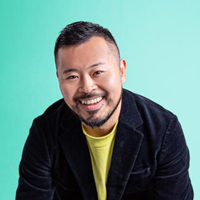
▼ Jake Dolosa
Art Director. After working as an in-house designer for the global luxury hospitality brands Mandarin Oriental Manila and The Peninsula Tokyo, Jake joined Shiitake Creative Inc. in 2022, overseeing all creative content, including photography and videography. Using his expertise and knowledge of the hospitality and luxury industry, Jake has been involved in various design communication projects focusing on presenting Japan's top content to overseas visitors and residents. An avid traveler seeking the best cat-friendly destinations in Japan.
Moving to Japan for work
You studied and worked in the Phillippines until 2018. What made you move to Japan in the first place?
I was offered a role at The Peninsula Tokyo while I was working in Manila. A former colleague told me they were looking for a graphic designer, so I decided to apply. It took about eight months to learn that my application was accepted. It was an impatient, long wait! (laughs)
Were you interested in Japan prior to that?
I really love Japan. I visited for the first time in 2017. Back then, I never imagined I would be moving here a year later. It was very exciting because I'm really interested in the Japanese art and design scene. In Tokyo, I was impressed with how cool the ads were. A lot of the prints, environmental design, and motion graphics were so creative and well-designed. Tokyo amazed me — it's both order and chaos.

How was the actual move to Japan? What were some of the biggest challenges in the initial adaptation process?
It was both exciting and exhausting. In the initial months, I was always going out and exploring new places. I went to places frequented by locals, discovering places left under the radar if you're a tourist. I went to exhibitions, art galleries, weekend markets, shotengais, and parks. It was so stimulating, and I was just thankful to live in a very lively city.
At the same time, the language barrier was a huge challenge for me initially. Back then, I had near-zero Japanese proficiency. I had to deal with paperwork, going to the city hall without translators – even having a haircut was a challenge. It was helpful to have friends already living in Tokyo, and, of course, meeting new friends and acquaintances was great. Looking back, it was a lot of happy memories.
How did having a job help you in the adaptation process?
Aside from financial benefits, having a job exposed me further to Japanese work culture. It was a great learning experience because it was a whole different dynamic from what I experienced working in Manila. It helped me adjust in a way that I was immersed in this environment that I wouldn't learn if I was just on a business trip.
Starting big, then slowing down …to speed up
Tell us a bit about your previous work experience.
I was already a graphic designer before coming to Japan. I've worked in different industries, both as an in-house designer and as a freelancer. I have notable experience in luxury hospitality, having worked in Mandarin Oriental in Manila and a locally renowned hotel chain in the Philippines. I have been freelancing with different companies and ad agencies, both locally and internationally (through remote work). My last experience in Manila was working in the biggest telecommunications company as part of their digital ventures team, handling the marketing creatives of their digital products. After that, I packed my bags and moved to Japan to join The Peninsula Tokyo as Graphic Design Manager, where I worked for over three years.
And then, in 2022, you decided to look for other opportunities. What was your motivation at the time?
I was looking for something more creative to broaden my portfolio. Having worked in hospitality marketing for quite some time, I was craving something broader, and I felt like Japan was where I had to exercise and further my creativity. I was also keen to work in a startup environment – somewhere completely different from what I've been used to, having worked in such big corporations.
Then you found Shiitake Creative. How did that happen?
I had just started applying for work after recharging from my break in Manila when Ally added me through LinkedIn. I checked Shiitake Creative and liked what I saw. I thought it captured what I was looking for at that time. It all happened really fast, and the next thing I knew, I was on a video call with Ally and Seiya, showing my cats (laughs) and talking about myself, the company, and the creative role. I was very much excited.

Compared to larger companies, what's it like working in a smaller business like Shiitake?
There are, of course, pros and cons. For example, working in big companies, there's already a structure that you work with. And all you have to do is either follow that or provide insight to change something you think is wrong. But sometimes, the ideas you present can be turned down because a lot of bureaucracy is involved.
On the other hand, working in a startup makes you more proactive. It makes you independent and dependent at the same time because the roles are very fluid. There are fewer people, and you get to multitask and do tasks outside your official role. What I like about it is that you have more freedom in the sense that the hierarchy is not that pronounced.
At big companies, it feels like you're being hindered and doesn't feel as creative. So a big reason I joined Shiitake is to be creative and to broaden my portfolio.
Small company, big opportunities
Tell us about your work and responsibilities at Shiitake.
As Art Director, I'm in charge of conceptualizing all the visuals and overseeing all creative projects and design production.
I do a lot of internal branding as well. For example, I'm currently working on an onboarding tool for newcomers to Shiitake. I've also worked on our new website, as well as even a bit of writing for social media. I also do photography, video editing, and motion graphics. I do a lot of stuff! (laughs)
What is a typical day on the job for you?
I begin my day by listing all the tasks that are due on that day, keeping in mind the weekly and monthly schedule and any internal or external deadlines. I then discuss with my colleagues anything that needs clarification.
I work alongside our CEO Seiya to tune in with work status and client requirements, Ally (CCO) in terms of copywriting, and Tyana (Graphic Designer) if she needs help with design work or if she needs advice on the art direction.
We typically start around 9:30 am and end the day at around 6pm. There are some times when I've had to do overtime, but that's quite rare.

Do you work mostly in English or Japanese? Are there issues with language barriers?
I work in English. There's no language barrier because everyone is so proficient in English.
I do have to sometimes attend meetings with our clients, though, which can be challenging language-wise. I have limited working proficiency in Japanese, so I can understand what they're saying but can't necessarily respond.
It's easily resolved, though, because there will always be a Japanese speaker from our team during a client meeting, and I can communicate any concerns after or during the meeting through them. Usually, if something is difficult for me, then I would ask for help from others to clarify, and it's an easy environment to ask.
You're working on many external and internal projects, so this may be hard to pick, but what's one of the most memorable projects you've worked on at Shiitake so far?
The most memorable would have to be a large-scale travel advertising project we did in 2022, shortly after I started at Shiitake. It was late in the pandemic when the borders were starting to reopen.
The project included designing and writing about 50 advertorial articles and straight ads that were to be published in various publications overseas to promote Japan. It was my biggest project yet in terms of scale. I was working with multiple publications around the globe and did all these advertorials and advertisements in different languages. It was very difficult as I was working with different print settings across each publication, but at the same time, it was an exciting and educational project because I got to further my knowledge of print work.
After seeing it printed, it was very fulfilling because I got to have my work published in different countries.

Sounds like a truly rewarding experience! But we're sure it's not just fun stuff. What are some of the most challenging parts of your job?
Other than the Japanese language, another challenging aspect is the Japanese market preference. I encountered this even in my first job here in Japan.
I've had my fair share of experiences creating a design that I thought was appropriate or appealing but was received otherwise in the Japanese landscape. At the same time, I've had times when I was able to provide something unique that surprisingly appealed to Japanese taste. So it's trial and error, and I'm learning more about the Japanese market each time. I try to do that by studying posters. I love looking at advertisements in train stations or reading brochures and getting inspiration from them.
My takeaway is that there should be a balance between providing something out of the box and at the same time paying respect to the culture and being sensitive to norms.
On the contrary, what is the most rewarding part of your job?
Seeing your design published, used, or praised by the clients. That's when I see the hard work has truly paid off. I get to extend a part of my identity to other people. As a designer, I'm helping them with their goals or design problems.
Design, to me, is not just providing something pretty or nice to look at but something that solves problems as well. As designers, we are problem solvers at the core. And we are tasked to address issues because you can see design everywhere. There's a reason a table has legs or that chairs are constructed the way they are. Everything is designed and has a purpose. I value being a designer because it's in everything you see.
Diversity and work-life balance
Shiitake emphasizes diversity and inclusion and strives to incorporate it into its company culture. As a designer, do you think that these values are important in the creative industry?
I think it's great to design with diversity and inclusion in mind because design is essentially for everyone and everything. Creativity stems from all sorts of places, experiences, interactions with people, and problems. In design and creativity as a whole, it is important to address issues and provide solutions that will benefit everyone.
What do you value in the workplace?
I definitely value a good work environment. To me, an ideal workplace is very collaborative, and where everyone respects and calls for each other's ideas. One of the reasons why people stay in a company is because of how their ideas and contributions are valued.
At Shiitake, it's all very casual. Since it's a very small team, it's very intimate, and everyone knows everyone. I think that's what makes it a lot easier for everyone to listen to each other's ideas. That's what I really like because I came from a former work environment where seniority is essential. My previous company was very multinational but also very Japanese in the corporate sense of the word — seniority was very important and the people below typically don't have as much say as those in managerial positions.
How do you find the work-life balance at Shiitake?
I like the fact that we log off on the dot most of the time. It's completely normal for a lot of Japanese companies to do overtime work, particularly managers. It's a different case at Shiitake, where I find my life outside of work is being respected. The hybrid structure is also nice because I get to work from home on some days, and I'm able to spend time with Zach, my partner, and our cats while working. Work-life balance is important to me because I get to do my other passions or go out to relax and socialize.

What are your future aspirations at Shiitake? What projects would you like to be involved in?
I’d like to take on bigger projects and use different media. Right now, I'm exploring a lot of video work and motion graphics. So, I think that's what I want to do. I think as designers, it's important to be relevant, explore new tools and media, and take on very challenging work outside of what we're used to.
What kind of people do you think will fit in the work culture at Shiitake?
I think open-minded people would work well at Shiitake. Someone who values their ideas as well as others.' People who find a balance between being independent and dependent. Given that we're in a startup environment, I think it's important for us to be proactive and creative because the roles are fluid.
My advice to anyone considering applying is to value yourself and your ideas. At the same time, be ready to approach things with an open mind. It's a collaborative environment, so I think that our new ideal co-worker has to come ready with their ideas, speak up when they have to, and still listen to other people.
Let's put work aside for a second. We hear that you're a fantastic chef, a cat dad, and just moved to a new home. How's life for you and what are some of your dreams outside work?
It's thriving! (Laughs) After work, I like making a nice dinner or baking bread or pastries (which I sometimes bring to the office!). On a normal weekend, I would explore the city or hang out in my favorite go-to places – it could be a cafe, a museum, a weekend market, a cool bar, or a park. If I don't go out, I'm usually cooking or playing with my cats. I actually just moved to Kichijoji, one of my favorite places in Tokyo, so I would always hang out there, exploring cafes/restaurants and shopping for cute market finds.
My dream is to have a bakery cafe. I love cooking and baking so much; if I hadn't pursued design, I would've been a baker. And since I also love cats and animals in general, I want to provide a shelter house someday for strays or abandoned animals. Maybe a rescue cat cafe/bakery? Who knows!

Last but not least, what's your secret ingredient that makes EVERYTHING better at work and at home?
Curiosity. I love to explore the unfamiliar, whether it's a new restaurant, an ingredient in a recipe, an artwork, a design trend, a book with an interesting cover or plot. There's always something to discover, and I think curiosity is a great fuel to making the most out of life. We've always had it as children, and a lot of times, it's discarded as adults when we become too comfortable in our routines or too afraid to explore unfamiliar territories. Always stay curious!
Thank you for your time, Jake!
Interview & Text by Cassandra Lord

/assets/images/20692948/original/bc2a0d12-9dc2-47e7-9f65-271ec636d626?1742354573)

/assets/images/20692948/original/bc2a0d12-9dc2-47e7-9f65-271ec636d626?1742354573)